Ski touring · freeride · a Val d'Isère school founded in 2001
Ski touring and freeride in Val d'Isère: where to go, and what it takes
Val d'Isère deserves a better place in the European freeride rankings. Here is what ski touring in Val d'Isère and its freeride hold for you, from a school that has skied these faces most days of the winter since 2001, with a fair word on how it compares with Chamonix.
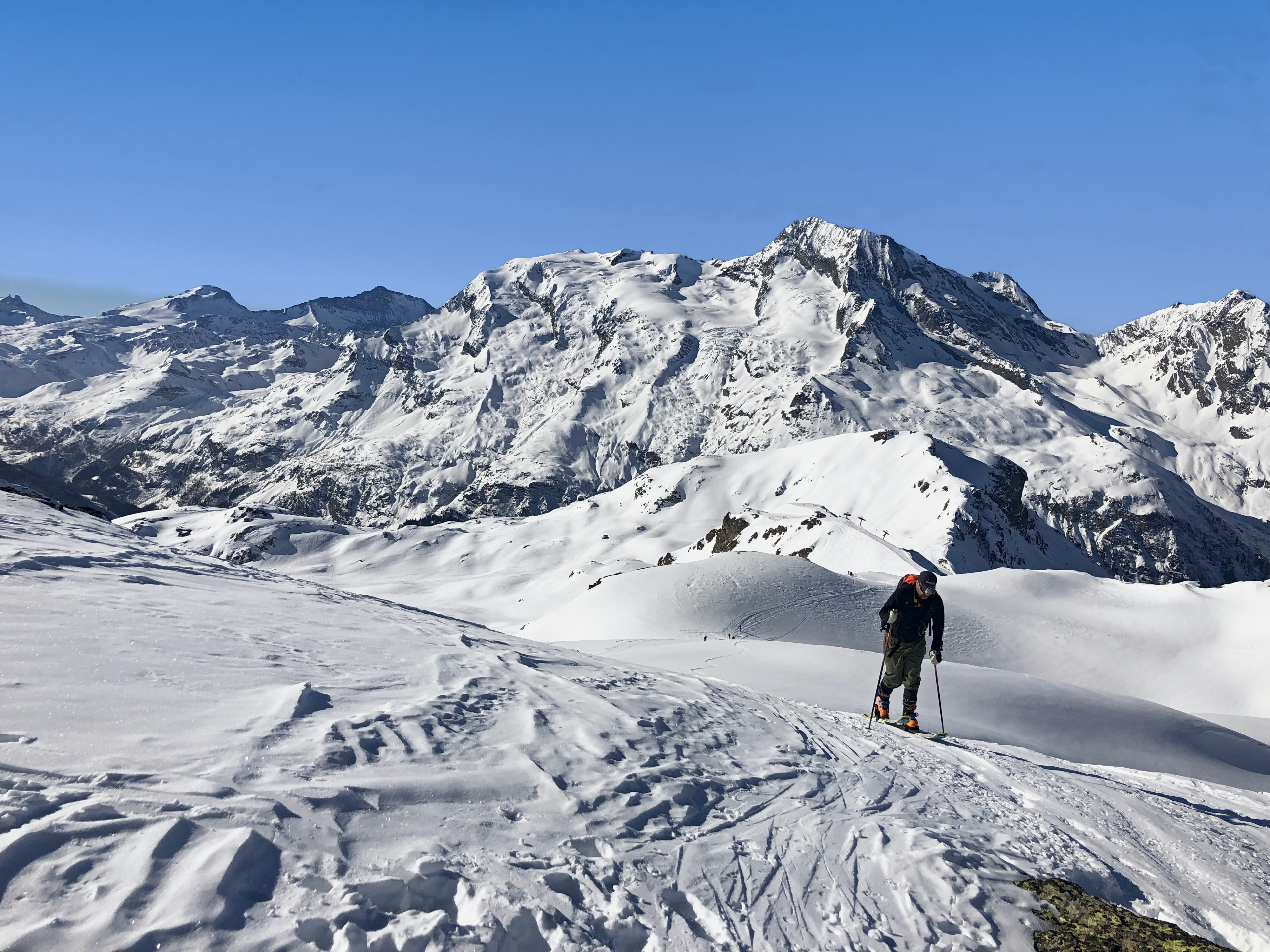
In brief
- What you'll find
- some of the largest lift-served off-piste terrain in the Alps, with quiet ski touring the moment you leave the flow
- Freeride
- long powder faces off Solaise and Bellevarde, reachable in minutes from the lifts
- Ski touring
- short skins to untracked slopes, plus longer valley tours towards the Pays Désert and the Col de la Sana
- Your level
- from a strong red-run skier curious about powder to the expert after a couloir
- Season
- lifts opening (late November, verify) through to spring corn in April, snow depending
- Who skis with you
- a qualified ski instructor specialising in off-piste; for the occasional route that calls for one, a mountain guide can be brought in on request
- Contact
- +33 6 51 66 58 53 · reply within 24 hours, in English, French or German
Ski a racing resort with a freeride soul
Open any European freeride ranking and you will read the same names: Chamonix, Verbier, Zermatt, La Grave, St Anton. Val d'Isère tends to sit just outside those lists, for a simple reason: the resort built its reputation on racing and on family pistes, while the off-piste stayed the locals' own. Since 2001 we have made our living sharing that secret.
Val d'Isère and the Espace Killy hold some of the widest lift-served off-piste terrain in the Alps: open bowls, rollovers and couloirs you can lap in an afternoon, then quiet touring the moment you skin away from the pistes. The high glaciated alpinism of Chamonix, with the Vallée Blanche and the Aiguille du Midi cable car rising to 3,842 metres, belongs to another mountain and another kind of day out. For the full picture on your guided days, sectors and prices, see our off-piste skiing in Val d'Isère page.
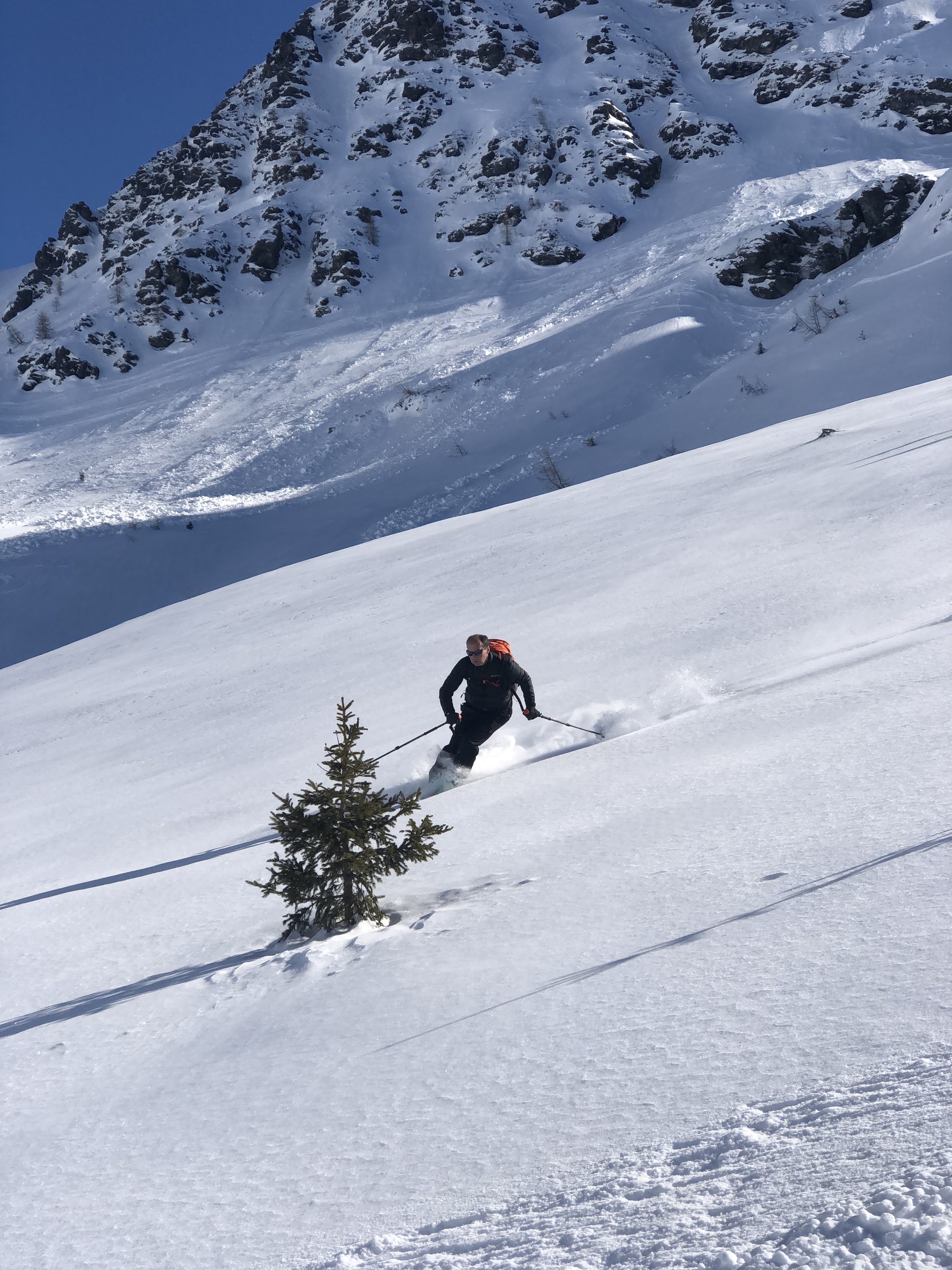
Freeride, a few minutes from the lifts
If you're new to freeride, Val d'Isère is unusually kind to you, and the best of it lies close at hand. Off Solaise, gentle open ground catches the morning sun, and as a strong piste skier you float in fresh snow on forgiving terrain. Off Bellevarde, a string of bowls and rollovers feeds one into the next, changeable and trappy on hard snow, exactly where you learn to read a slope before you commit to it.
For the very strong, the resort keeps its harder currency: the Couloir des Pisteurs, steep and narrow from the top, a true no-fall line and one of the hardest above the village. We keep it for expert skiers, guided and equipped, on the days the snow allows. That range under one lift system, from first powder turns to a serious couloir, is the real case for freeride in Val d'Isère.
Ski touring: from your first short skin to full days out
For a resort, Val d'Isère is well set up for touring, and newcomers enjoy ski touring in Val d'Isère as much as hardened tourers do: ten to thirty minutes on skins is often all it takes for you to drop onto a face still untracked since the last snowfall. A few kick turns, a steady pace, and the slope next to the busy one is yours.
Beyond the quick skins, longer valley tours open up, towards the Pays Désert, the Col de la Sana, and the high cols that link across to Bonneval-sur-Arc. These are proper full-day outings, ascent and untracked descent, with the lifts left behind entirely. Bonneval, Sainte-Foy and La Rosière also feature in our off-piste day trips in the Tarentaise. Once the rhythm has you, carry on with our ski touring courses in Val d'Isère, where we work on the kick turn, the pace and the terrain reading with you over several days. And when you'd like long high-altitude vertical without the climb, we'll point you towards heliskiing on the Italian side.
Val d'Isère or Chamonix: choose the day that suits you
The question comes up all winter. The short answer: they are two different kinds of mountain, and choosing between them means choosing your style of day.
Chamonix is high-alpine terrain, glaciers, seracs, big committing descents reached by cable car and often roped up. It rewards the experienced ski mountaineer and demands a mountain guide as a matter of course. Val d'Isère is a lift-served off-piste and touring resort: more accessible, more forgiving for the skier stepping off the pistes for the first time, with the option to go quiet and remote on skins when you want it. Each excels at its own kind of day. Chamonix suits you if you want glaciated commitment; Val d'Isère, if you want a lot of skiable off-piste, an easier learning curve, and a shorter way to the good snow.
Side by side:
- Val d'Isère · village ~1,850 m · lift-served high point 3,197 m (Pissaillas glacier, Montets drag lift, verify) · exposure: broad range, many north and east faces holding snow · level: strong red-run skier upwards · guiding: qualified off-piste instructor, a mountain guide for the occasional route that requires one · season: late Nov–early May, snow depending
- Chamonix · valley ~1,035 m · lift-served high point 3,842 m (Aiguille du Midi) · exposure: high glaciated north faces · level: solid off-piste to expert ski mountaineer · guiding: mountain guide as standard on glaciers · season: Dec–May, glaciers into summer
- La Grave · village ~1,450 m · lift high point ~3,200 m (verify) · exposure: steep, unpatrolled glaciated terrain · level: expert only · guiding: strongly advised
- Verbier · village ~1,500 m · lift-served terrain around the Mont-Fort ~3,330 m (verify) · exposure: broad freeride bowls and couloirs · level: intermediate off-piste to expert
The takeaway: if a ranking sends you to Chamonix for a glacier descent, that is sound. If you want a week of varied off-piste and touring where a competent piste skier can genuinely progress, Val d'Isère is the stronger base.
The level you need to join us
For freeride off the lifts, you need to link your turns down a red run, on hard snow and spring snow alike, and hold your balance on ungroomed snow. That is the threshold; from there, curiosity counts for as much as technique. We take children out from around ten once they're settled on the ski area, and we guide strong skiers well past eighty.
For touring, add a willingness to climb at a steady pace for anything from ten minutes to a couple of hours; the technique is quickly learned. For the committing couloirs and north faces, you need real off-piste mileage and a good head for exposure, and even then, the snow decides. Meet Boris and the team to see who you'd be skiing with.
Made for you if you are:
- A strong piste skier ready for your first powder turns, a few minutes from the lifts
- An intermediate off-piste skier after terrain variety and quiet touring in one place
- An expert after couloirs and long faces, guided, on the right day
Best begun elsewhere if you are:
- Set on a classic glacier descent like the Vallée Blanche: that's a Chamonix day
- Still finding your feet on blue runs: you'll progress fastest with our ski lessons first
Your guiding and safety, every morning
Off-piste and ski touring take place on unmarked terrain beyond the piste patrol's care, so with us you always go out guided, by a qualified off-piste ski instructor or mountain guide. You're handed an avalanche airbag pack, a transceiver, a shovel and a probe at the start, and we check that every transceiver transmits and receives before we move. All of it is included in the price.
We read the snowpack every morning, weighing the Météo-France avalanche bulletin against what we saw on the ground the day before and settling on your sector to match. We judge each slope afresh, whatever it gave the day before. When the danger rises, we adapt, choosing slopes below 30 degrees and keeping well clear of the steeper ground above. Reading the snow and picking the right slope at the right hour: that judgement is what you gain by skiing with a professional. Our avalanche safety page goes through the 1 to 5 scale and wind slabs in detail.
Safety comes before every turn. Ski touring and freeride in Val d'Isère take place on unmarked terrain, beyond the reach of the piste patrol. We provide and check the safety kit before every departure (avalanche airbag pack, transceiver, shovel and probe). We follow the avalanche bulletin and the state of the snowpack daily, and we adapt, or postpone, every outing according to the conditions. In the mountains, risk is managed by preparation, by reading the terrain and by the good sense to turn back when you must; the kit is there to back that judgement.
FAQ
Is Val d'Isère good for off-piste skiing?
Yes, it holds some of the widest lift-served off-piste terrain in the Alps, from the gentle open ground of Solaise for first powder turns to the Couloir des Pisteurs for very strong skiers only. The advantage over higher alpine resorts is access: the good snow sits minutes from the lifts.
Is Val d'Isère good for ski touring?
For a resort, it's well set up. Short skins of ten to thirty minutes reach untracked faces beside the busy pistes, and longer valley tours run towards the Pays Désert, the Col de la Sana and the cols linking to Bonneval-sur-Arc. Newcomers to touring start here with ease.
How does Val d'Isère compare to Chamonix for backcountry?
They're different mountains. Chamonix is high glaciated terrain, cable-car access to 3,842 metres, big committing descents, a mountain guide as standard. Val d'Isère is lift-served off-piste and touring: more accessible, more forgiving for skiers new to it, with quiet touring on tap. Choose Chamonix for a glacier descent, Val d'Isère for varied off-piste where you can genuinely progress.
Do I need a guide in Val d'Isère?
Beyond the marked pistes the terrain is unpatrolled, so guiding is strongly advised, and with us it's included. You go out with a qualified off-piste ski instructor (a mountain guide joins on request for the occasional route that requires one), with an avalanche airbag pack, transceiver, shovel and probe provided, and the snowpack read each morning.
What level do I need for freeride in Val d'Isère?
You need to link your turns down a red run, on hard snow and spring snow alike, and hold your balance off the groomed. From there we build: powder beginners start on Solaise, experts head for the couloirs and north faces when conditions allow.
When is the best time for ski touring and freeride in Val d'Isère?
Powder freeride runs through the heart of winter, roughly January to March, snow depending. Spring brings corn snow and longer touring days into April. Exact lift opening and closing dates are worth checking against the current season before you book.