Off-piste for riders · Val d'Isère since 2001
Off-piste snowboarding in Val d'Isère: ride the powder, head out on a splitboard
Off-piste snowboarding on the open slopes of the Espace Killy, or a splitboard introduction to reach the snow beyond the lifts, guided, on terrain chosen for boards.
In brief
- Your level
- linking your turns on a red run is enough for your first off-piste outing; a bit more mileage for splitboarding
- How long
- full days, a single day, several in a row to progress, or a whole week
- Group size
- 1 to 6 people, private guiding
- Kit provided
- avalanche airbag pack, transceiver, shovel and probe; a complete splitboard on loan for the introduction
- Meeting point
- 8 am, outside the Val d'Isère tourist office (Avenue Olympique)
- Price
- from €600 a day for the group (1 to 4 people)
- Season
- December to May, snow depending
Off-piste, where your snowboard comes into its own
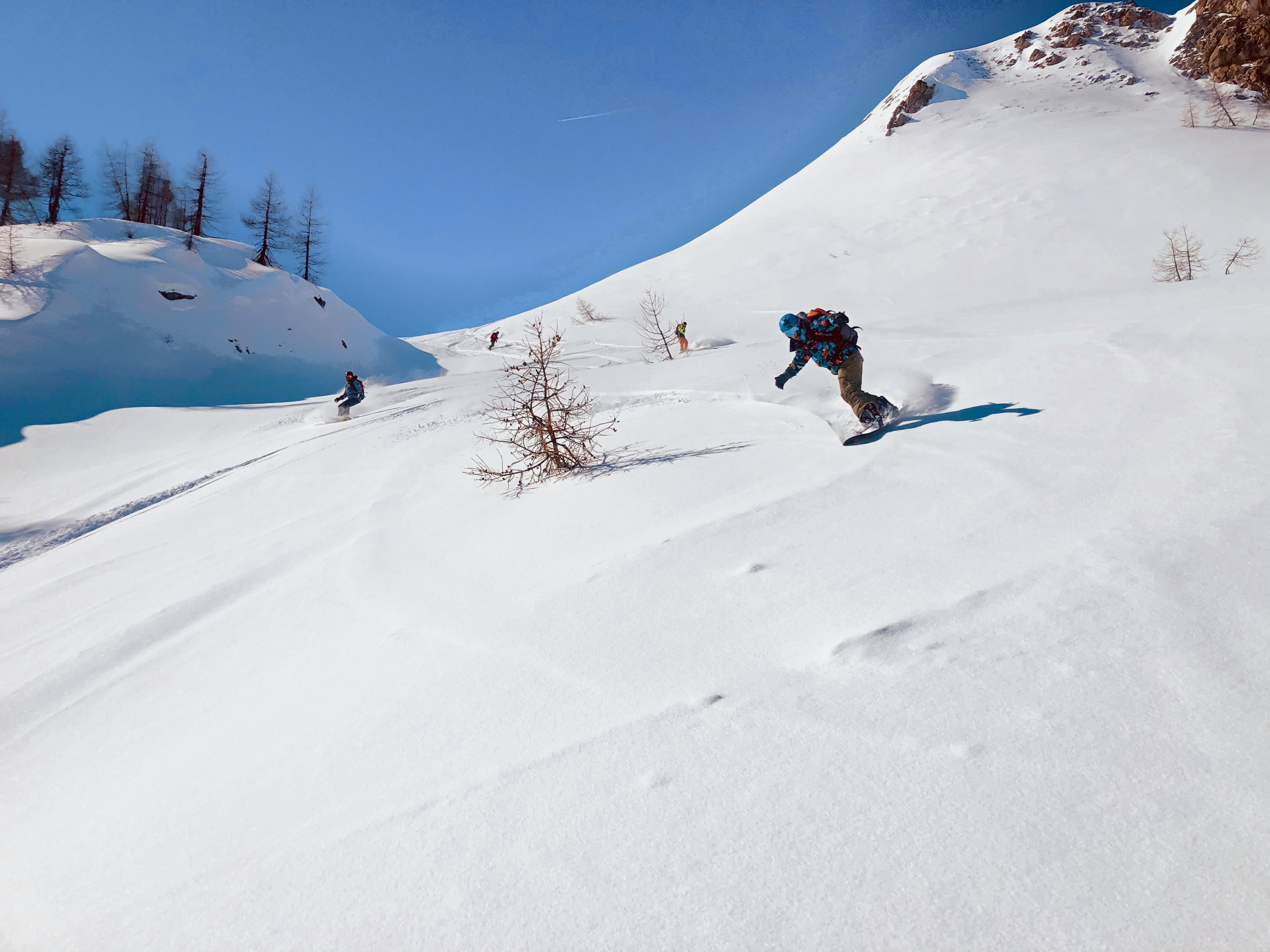
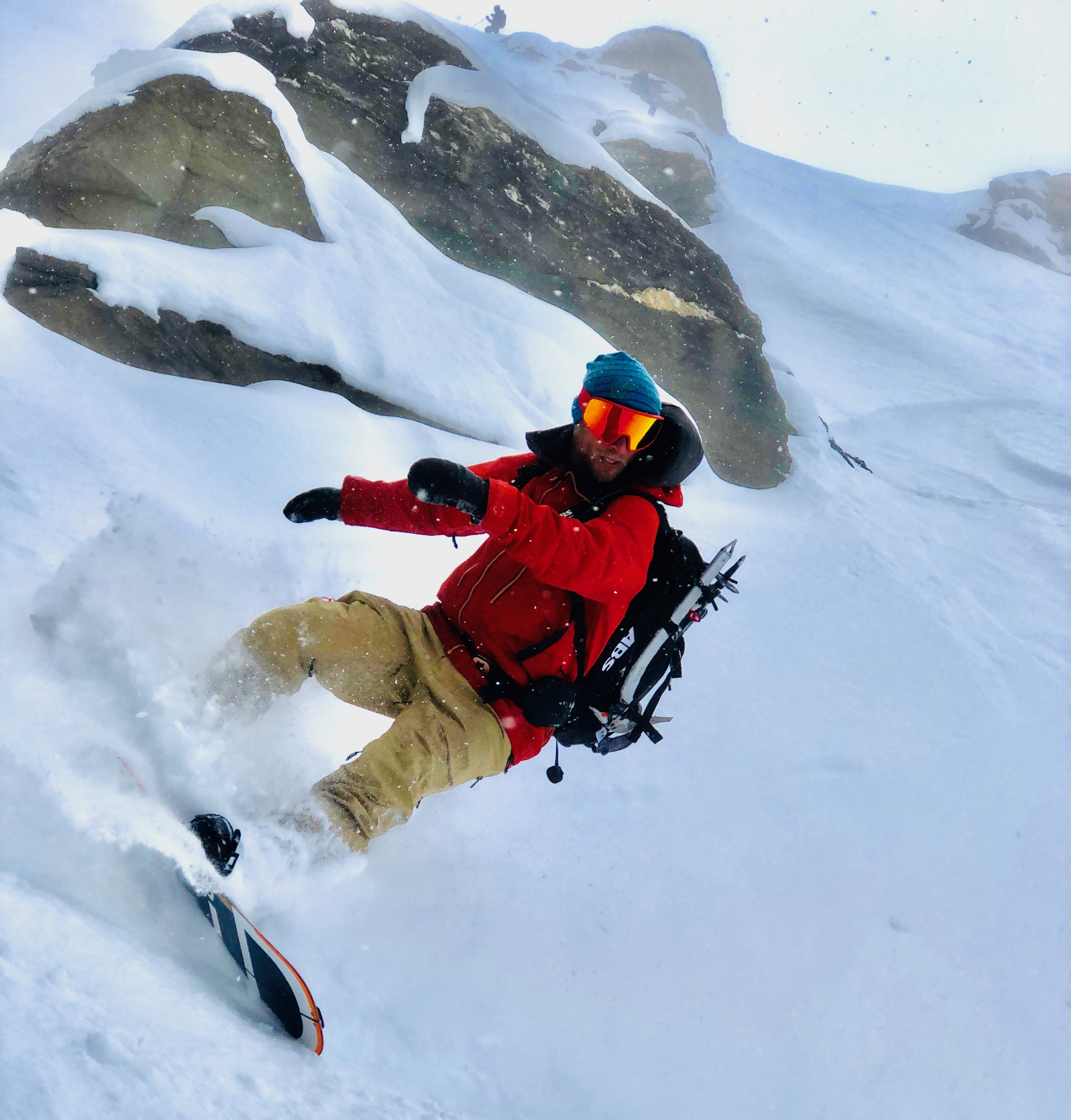
On a groomed run, a board does what it's asked without much in the way of surprise. In thirty centimetres of fresh, everything changes, the nose lifts on its own, the back foot sinks, the board rides up on the snow and starts to float, and you understand at once why surfers took to the mountains. That's off-piste snowboarding, or backcountry snowboarding as American riders call it: a conversation with the slope as much as a sequence of turns. Val d'Isère and the Espace Killy give you generous terrain for it, from the big open bowls up high to sheltered hollows where powder keeps for days after a storm.
Since 2001 we have been taking riders into the powder, privately or in small groups. Each session starts with us watching how you ride; then we pitch the terrain to your ease and take you where the snow is good on the day. As a curious piste rider, you lay your first tracks on a gentle, open slope; with more mileage behind you, you head for a steeper bowl. Either way, the pleasure comes from the same place, that floating feeling, and a slope still untouched until your track.
Splitboarding: climb on skins, ride down on your board
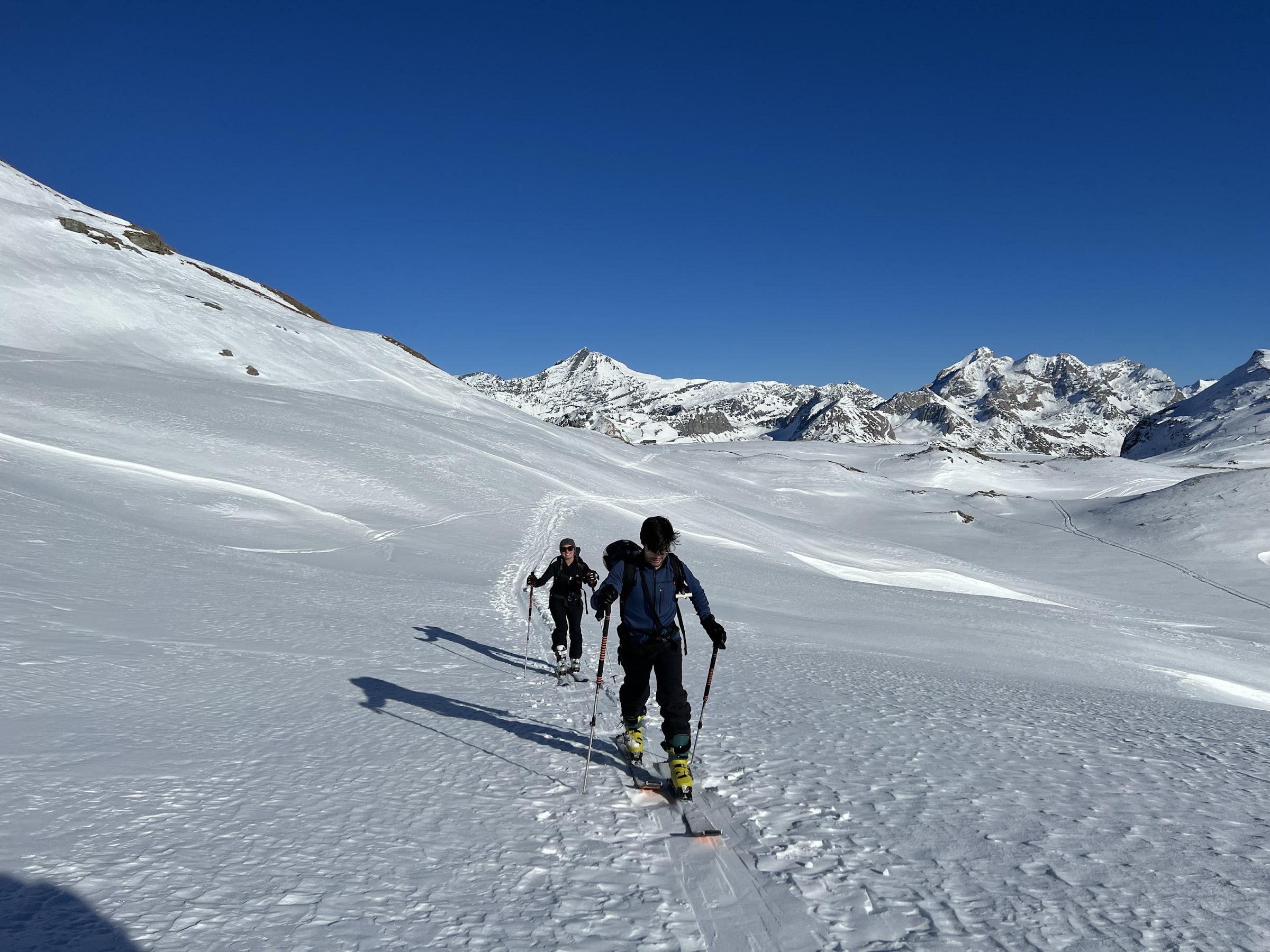
You know the pull of the snow just beyond the last lift. The splitboard answers it beautifully. It's a snowboard that splits in two lengthways: on the way up, the two halves become a pair of skis with climbing skins on the bases, and you climb as you would on a ski-touring day; at the top, you put the board back together, stow the skins and ride down as a snowboard. It's the tool that opens up all the terrain beyond the lifts: a hidden hollow, a quiet shoulder, a north-facing bowl holding its powder.
The idea goes back a while: from the early 1990s a few riders were already sawing their boards in half to get up where only ski tourers went. Modern kit has made it all reliable and accessible, and the splitboard introduction has become one of our most requested days. We lend you the complete board for the introduction: come and try it before you buy.
Our prices are simple and apply to all our guided activities, per group and per day.
- Outside school holidays · 1 to 4 people: €600 a day
- Outside school holidays · 5 to 6 people: €700 a day
- School holidays · 1 to 4 people: €650 a day
- School holidays · 5 to 6 people: €750 a day
Included: guiding by a qualified off-piste instructor, the full safety kit (avalanche airbag pack, transceiver, shovel and probe) and, for the introduction, the loan of the splitboard. Extras: lift passes, board and boot hire, transfers, meals and insurance.
→ See the full price list and conditions: our prices
For your first track in powder or your first splitboard tour, tell us your dates and your level, and we'll choose the format together and ride out on the right day.
Splitboarding: how your board climbs, then rides
The board that splits
A splitboard is built to come apart into two halves lengthways. Side by side, board assembled, you'd barely notice; unlock the clips and you have two separate "skis". Each half carries its inserts, the mounting points the bindings screw or clip onto depending on the mode. All the mechanics come down to switching from one state to the other, which is called the transition.
The climb: skins, tour mode, ski crampons
To climb, you split the board, set the bindings in tour mode (free at the heel, as on touring skis) and stick a climbing skin under each half. The skin grips on the way up and glides forward, so you move up steep ground without slipping back. When the snow hardens or the slope steepens, you add ski crampons, small blades that bite into hard snow. You then climb exactly like a ski tourer, at your own pace, one step after the other.
Your transition, the little summit ritual
At the high point you make the transition: peel the skins off and stow them, join the two halves back into one board, and switch the bindings to ride mode (fixed, across the board, like any snowboard). The first few times it takes a few minutes and slightly numb fingers; after three or four outings it becomes second nature. That's precisely what we teach on the introduction, a clean, quick transition, even in a cold wind.
The descent: a real snowboard
Once the board is back together, you ride down like any other snowboard. Modern splitboards ride very well in powder; the float is there, all of it. A slight difference in weight and feel fades away in fresh snow.
Made for you if you love the snow beyond the lifts
Splitboarding suits you if you're at ease riding off the groomed runs and keen to skin up to snow beyond the lifts. Skinning is a matter of rhythm more than power, well within reach of any keen rider. For a first introduction you need to ride an ungroomed slope comfortably, the rest (skins, transition, pacing) you learn on the spot, from the first outing.
Off-piste snowboarding: the level you need for your first powder
Off-piste snowboarding is closer to hand than you might think. For a first powder outing, linking your turns down a red run with ease is enough: the floating technique, weight back, let the nose breathe, play with the back foot, is learnt on the spot, on a gentle, open slope. We're happy to take teenagers from thirteen or fourteen, with their family or on their own.
Beyond the first time, it's all a question of measure. A steeper bowl, spring snow or an exposed shoulder call for mileage and a read of the terrain. Your instructor sets the day's objective by what your group can ride, safely and with pleasure.
Terrain chosen for your board
A snowboard loves a slope that keeps its pitch. Where a skier can pole along a flat traverse, a rider would have to unstrap and walk, so we choose our routes accordingly. In Val d'Isère and the Espace Killy we favour open slopes and bowls that keep rolling, with approaches that keep you riding.
In practice, and for splitboarding especially, that also means direct climbs rather than long sidehilling. The area lends itself well to it: big high snowfields, faces that hold the powder, and enough to link run after run with both feet in the bindings. The day's exact route is confirmed with your instructor according to the snow and the bulletin.
Your safety on unpatrolled snow
Off-piste snowboarding and splitboarding take place on unpatrolled terrain. Conditions change fast: wind, fresh snow, slabs, a thaw, a refreeze, visibility, tiredness, a slope within reach can become committing within hours. So on every outing you ride with a qualified off-piste ski instructor or mountain guide, who reads the avalanche bulletin every morning, knows the local snowpack by heart and has the judgement to call the day. Turning back at the right moment is a mark of real mastery.
You set off with an avalanche airbag pack, a transceiver, a shovel and a probe, checked before every departure; you practise with them from the first outing. Several of our areas border protected land, the Vanoise National Park and nature reserves, whose zoning and wildlife quiet periods we respect. To read the daily bulletin with us, see our page on avalanche safety.
What we lend you, and what to bring
Provided by us: avalanche airbag pack, transceiver, shovel and probe, checked at the start. For the splitboard introduction, we lend the complete board, halves, skins, ski crampons and bindings, so you can try it before you buy. On a classic off-piste snowboard session you bring your own board, boots and helmet; otherwise we arrange hire for you in advance.
For clothing, the off-piste rule fits in one word: layers. You warm up on the splitboard climb and cool down at the transition and the top. Bring three breathable layers, a light down jacket for the changeover, spare gloves, sunglasses and goggles, sun cream and something to eat and drink. Your instructor checks your pack before you set off.
Plan your outing: meeting point, timing, booking
- Meeting point: 8 am outside the Val d'Isère tourist office, Avenue Olympique.
- A typical outing: briefing and kit check, access to the sector, the off-piste outing (climbing on skins for splitboarding), stops as the day goes, back in the late afternoon, depending on conditions.
- Transfers: some outings start from another sector; arrangements are settled the day before.
- Booking: we settle the date and format by phone or through the form below.
- Languages: guiding in English, French and German.
A word from the founder
Snowboarding came first, and the first time I saw someone split their board at the foot of a slope and head off on skins, up where only skis seemed able to go, it changed everything. Today, on each of our outings, you ride with a qualified instructor who specialises in off-piste, matched to your level and to the snow of the day: that is how we like to work.
Boris Malesset, founder of PowderWeGo, off-piste professional since 2001
Off-piste snowboarding and splitboarding take place on unpatrolled terrain. Conditions change quickly: wind, fresh snow, slabs, a thaw, visibility, a refreeze, crowds and tiredness can turn an accessible outing into a committing route. We recommend that you ride with a professional, check the Météo-France bulletin, carry an avalanche airbag pack, a transceiver, a shovel and a probe, and know how to use them, and keep a genuine readiness to turn back.
FAQ
How does a splitboard work?
It's a snowboard that splits into two halves lengthways. On the way up you stick climbing skins under both halves and climb as you would on a ski-touring day; at the top you put the board back together and ride down as a snowboard. It's the tool for riding the snow beyond the lifts.
Do you need to be a good rider to start off-piste?
For a first outing, linking your turns down a red run with ease is enough. The floating technique in powder, weight back, let the nose breathe, is learnt on the spot, on a gentle, open slope, from your first day with us.
Do I need my own splitboard for the introduction?
No. We lend the complete board (halves, skins, ski crampons and bindings) for the introduction, so you can try the sport before you buy. You bring your snowboard boots and personal kit; we take care of the rest.
Are flat sections a problem on a snowboard off-piste?
They can slow a snowboarder down, which is why we choose routes made for boards: open slopes, bowls that keep rolling, direct splitboard climbs, all planned so you stay strapped in.
Is a splitboard hard to handle?
Skinning up is quick to pick up; it's about rhythm more than strength. The part that takes a little practice is the transition at the top: split, skin, rejoin. The first few take a few minutes; after three or four outings it's second nature. We teach it from the introduction.
When is the best time to ride powder in Val d'Isère?
December to May, snow depending. Midwinter brings the best powder and sheltered bowls that hold it for days; spring snow, more stable after the overnight refreeze, suits high splitboard outings well.