Val d'Isère · Tignes · Tarentaise
Heliskiing from Val d'Isère: a glorious run down into the Maurienne, and back by heli
You reach a col on skins, ski fifteen hundred metres of untracked snow and find the helicopter waiting at the foot of the valley, all from Val d'Isère and within French law.
In brief
- Two formats
- a reverse heliski, legal in France, and the classic heli drop over the border in Italy
- Departure
- Val d'Isère (Le Fornet or Solaise, depending on the format)
- Group
- 1 to 4 skiers + their instructor or guide (helicopter capacity 4 + 1)
- Level
- a strong skier at ease off-piste: powder, crust, spring snow
- Typical descent (reverse)
- +50 m of climbing, about 1,500 m of descent to Bonneval-sur-Arc
- Safety kit provided
- avalanche airbag pack, transceiver, shovel and probe
- Season
- December to late April, snow and weather depending
- Price
- on request (heliskiing sits outside the school's standard prices)
Try reverse heliskiing, the French way
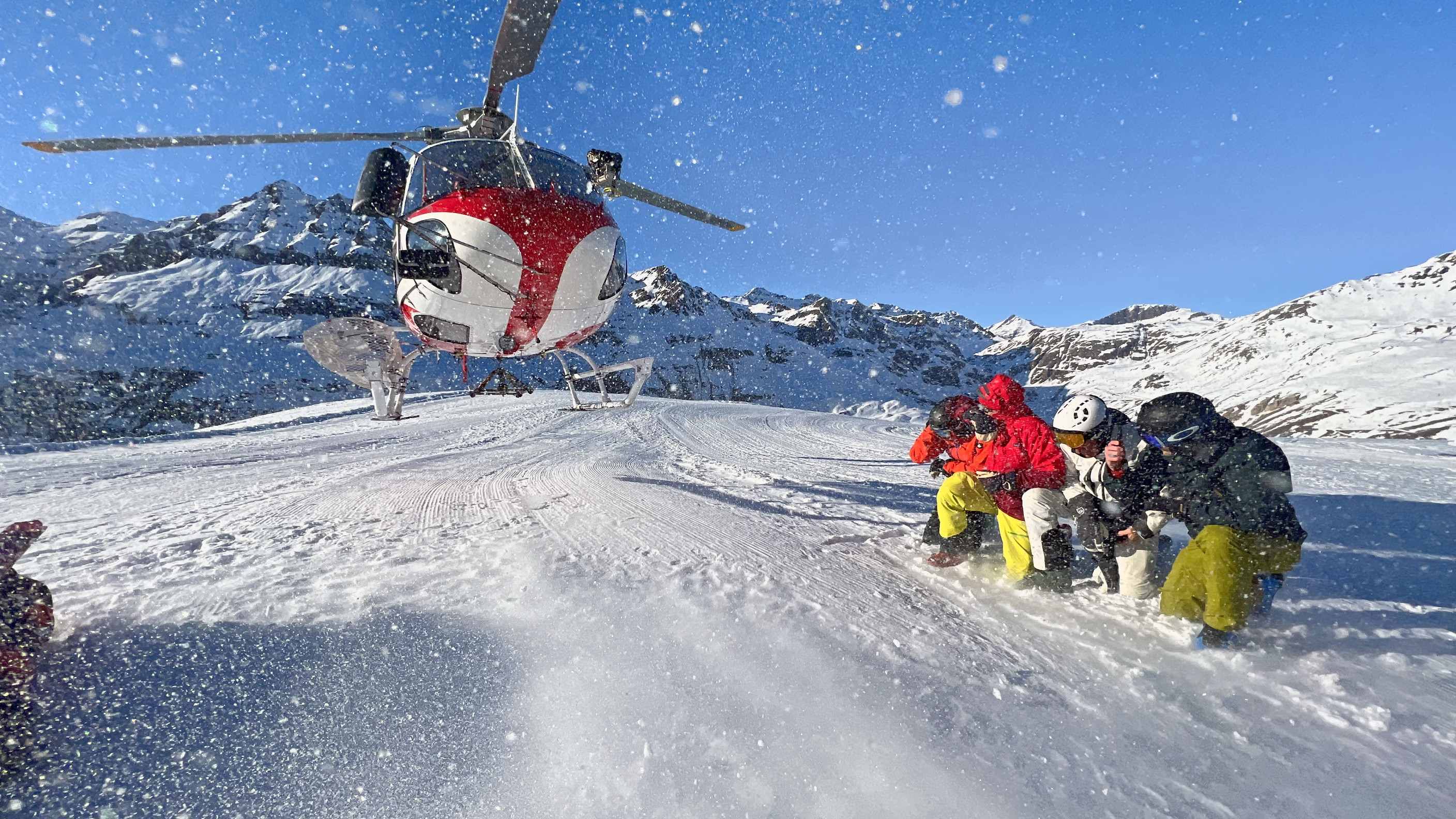
We are asked every winter, often at the lift counter, pass in hand, whether there is any heliskiing in Val d'Isère. The answer turns on one distinction. In France the helicopter may collect skiers at the bottom of a descent, and the drop up high is left to our Italian neighbours. So we ski it the other way round, which is why it is called reverse heliski.
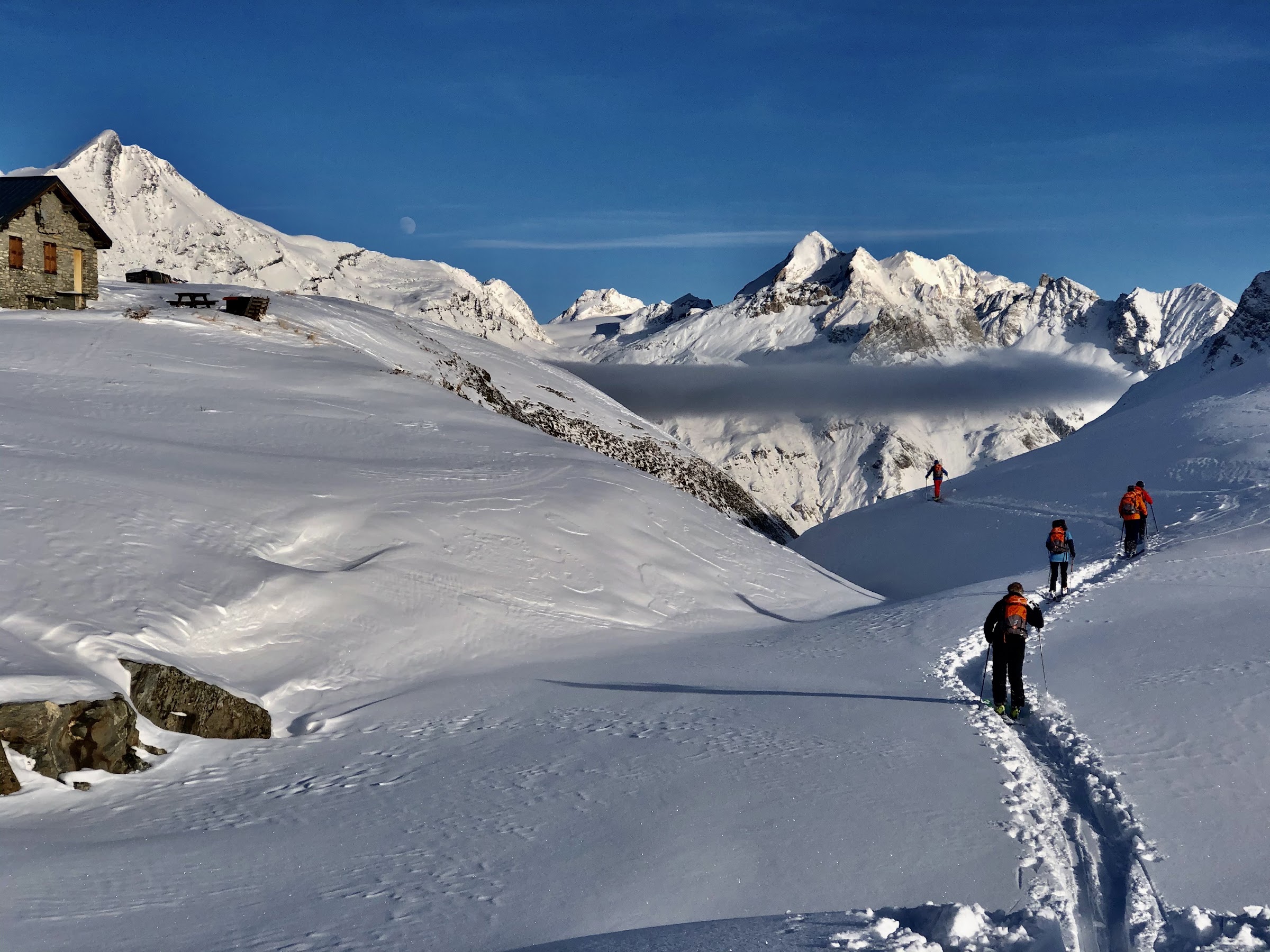
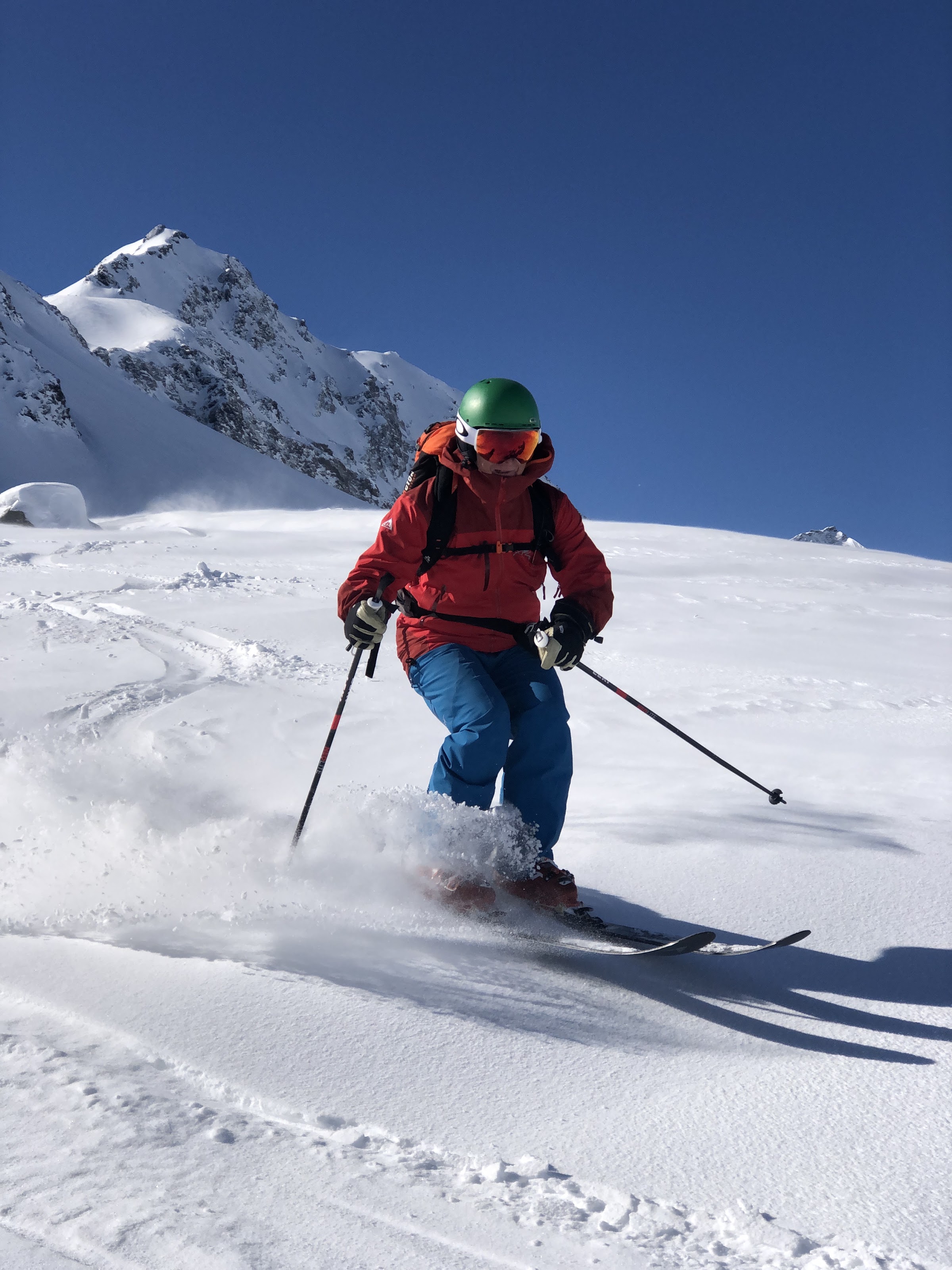
The day begins on skins. From the Pissaillas glacier above Le Fornet (the top drag lift reaches around 3,197 m, the glacier itself rising past 3,141 m), a gentle fifty-metre climb takes you over the Col de l'Ouille Noire. Beyond it lies the Vallon des Montets, a long, wild descent that holds its cold snow all the way down to the stone hamlet of L'Écot and on to Bonneval-sur-Arc: fifteen hundred metres of vertical, far from any pylon or piste. At the bottom, the heli is waiting to fly you back towards Solaise, with time left for the ski area in the afternoon. Entirely legal, and a full mountain day in its own right.
Fly up high: heliskiing in Italy and across the Swiss border
Across the border, heliskiing in Italy keeps the classic drop up high, fully within the law. Seven bases are within reach. The nearest, Valgrisenche, La Thuile and Courmayeur, make a fine day out; the furthest, Cervinia, Monte Rosa, Sestriere and Zermatt, with its great glaciers on the Swiss side of the Matterhorn, call for a stay. The two experiences differ, and we steer you towards one or the other according to your level, how the snow is lying and what the day calls for.
Either way, we arrange everything, from the heli slot and the French avalanche bulletin (BRA) read at first light to the journey home. You arrive in the morning and ski. On the Italian side, the Aosta Valley avalanche bulletin covers the bases from Valgrisenche to Cervinia.
Heliskiing sits outside the school's day rates (€600 to €750 per day depending on the season and group size, see our prices). Flight, guiding and logistics are built for each outing, so it is quoted on request, once we know your level, the base and the number of skiers.
- Included (depending on the format) · qualified instructor or guide, full safety kit (avalanche airbag pack, transceiver, shovel, probe), organisation of the flight and logistics.
- Extras · lift pass, ski equipment rental, meals, insurance, road transfers.
- Weather · if the flight proves impossible on the agreed day, we refund the difference between the heli-flown outing and the day actually skied. You pay only for what you fly.
Your reverse heliski: a short climb, a long wild line
French law permits the helicopter pick-up at the foot of the valley and reserves the drop up high for other countries. Reverse heliski makes the most of it: a few minutes on skins, a long descent through wild country, and the heli to spare you the road back. The fifty metres of skinning on the Ouille Noire route usually take under a quarter of an hour, guided.
From Le Fornet to Bonneval-sur-Arc, hour by hour
- 8 a.m., meet in Val d'Isère, safety-kit check (avalanche airbag pack, transceiver, shovel, probe), briefing on the snow and the route.
- Morning, lifts up to the Pissaillas glacier, skins on, fifty metres to the Col de l'Ouille Noire.
- The descent, the Vallon des Montets, around 1,500 m of vertical, powder or spring snow depending on the aspect, down to L'Écot and Bonneval-sur-Arc.
- Midday, a pause in L'Écot, one of the finest hamlets of the upper Maurienne, or lunch at Bonneval.
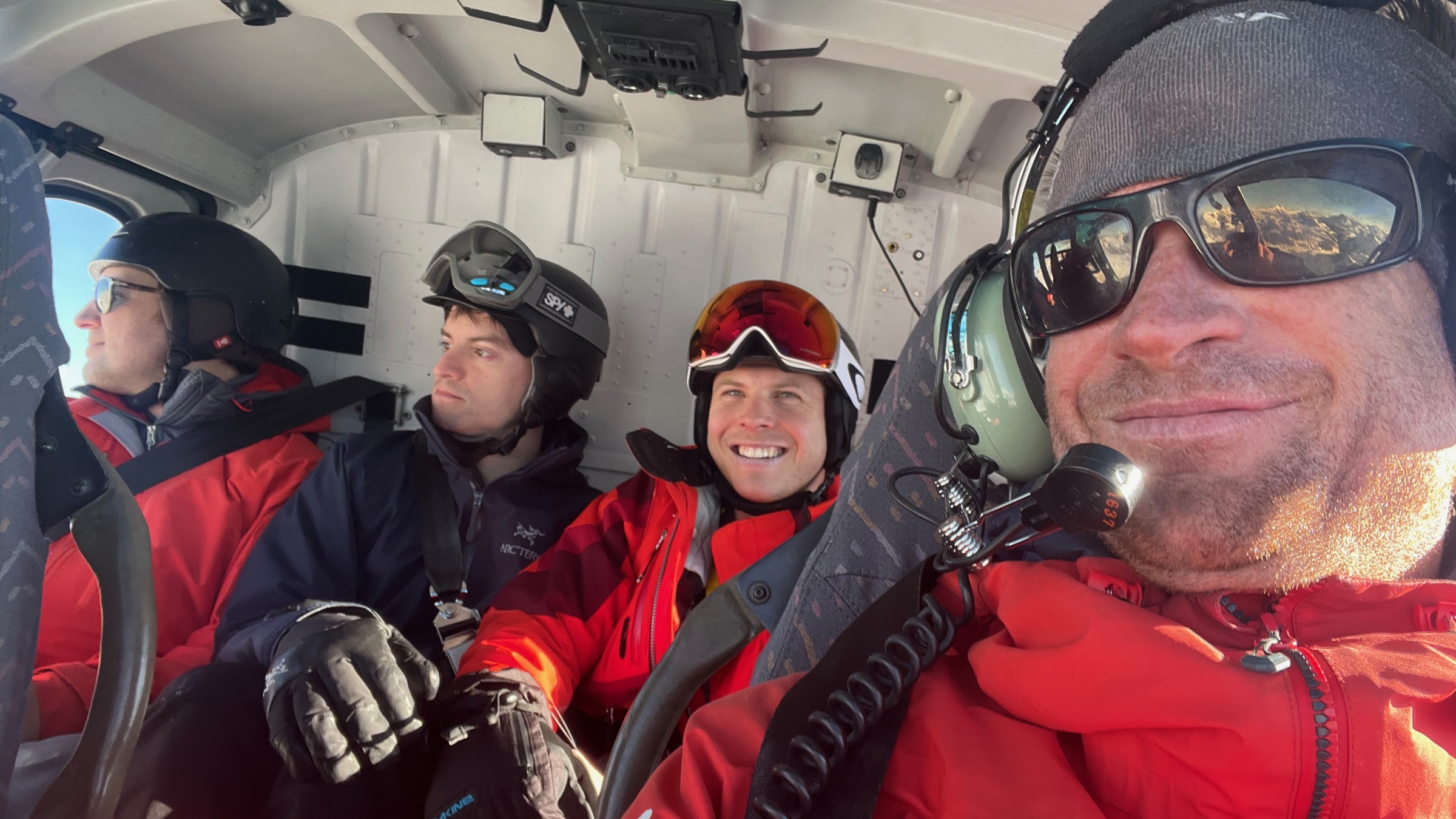
- The flight back, the helicopter collects the group (4 skiers + instructor) and sets down near Solaise, often with time left to ski the afternoon.
The programme may change: route, timing and pick-up point depend on the snow, the weather and the flight window. We adapt, or turn back, on the day.
Choose your base across the border, nearest to furthest
We reach them by road, by minibus, or by helicopter transfer when time is short.
- Valgrisenche, the nearest, beyond the Grande Sassière: a quiet cirque where the Giasson descent keeps its powder late. → Heliski Valgrisenche
- La Thuile, long, even faces on the Rutor massif, ideal for a first heli drop. → Heliski La Thuile
- Courmayeur, the Italian side of Mont Blanc, great glaciers and big vertical for solid skiers. → Heliski Courmayeur
- Cervinia, beneath the Matterhorn, vast glacier lines and the crossing towards Zermatt. → Heliski Cervinia
- Monterosa (Gressoney, Champoluc, Alagna), the highest drops in the Alps, above 4,000 metres, for experts. → Heliski Monterosa
- Sestriere, the furthest of the Italian bases, yet the one our guests ask for most, with a wealth of descents above the Olympic road, enjoyed as a stay. → Heliski Sestriere
- Zermatt, the Swiss side of the Matterhorn; flights leave the Zermatt heliport for the federally designated mountain landing sites. → Heliski Zermatt
If you're torn between two bases, tell us your level and the number of days, and we'll build the route with you.
Who skis with you, and how we keep you safe
Each outing is led by an off-piste ski instructor or mountain guide, and the group stays at one to four skiers. The avalanche airbag pack, transceiver, shovel and probe are provided and checked before take-off. The bulletin is read each morning and the snowpack watched on the ground. We adapt as the hazard changes, and know when to turn back.
Save time with a helicopter transfer
The heli also shortens the way to the Italian bases and links Val d'Isère to the region's airports: helicopter transfers from Val d'Isère, on request.
A word from the founder
Since 2001 we have made our living from off-piste skiing, and our skis have taken us from the Alps to Japan, from Iceland to Svalbard. We have led guests down the Ouille Noire reverse heliski in every kind of snow, and we still prefer it to many a summit drop: you set off from a col, and the whole day tells a story. You ski with a qualified off-piste ski instructor who knows the valley by heart; where a route requires a mountain guide, as on the glacier drops across the border, one leads the day.
Boris Malesset, founder, PowderWeGo
Heliskiing takes place on unpatrolled terrain, exposed to avalanche risk. Every outing starts with the morning bulletin, a check of each skier's avalanche airbag pack, transceiver, shovel and probe, and a briefing. We provide all of it. Your instructor or guide decides the route and may turn back at any moment; the level required, a strong skier at ease in all off-piste snow, is stated at booking.
FAQ
What is heliskiing, and how does it work from Val d'Isère?
Heliskiing means using a helicopter to reach long, untracked descents far from any lift. From Val d'Isère it takes two forms: reverse heliski in France, where you climb a short way on skins and the helicopter collects you at the bottom, and the classic drop up high in Italy, twenty minutes' flight away.
Is heliskiing legal in France?
Partly. French law permits the pick-up at the foot of the valley, the principle of the reverse heliski we run from Val d'Isère, and bans dropping skiers in the mountains. For the classic drop up high, we cross into Italy, where it is fully legal.
Do I need to know ski touring for reverse heliski?
No. The Ouille Noire route asks for only a fifty-metre climb on skins, on a gentle slope, within any strong skier's reach. Your instructor is with you from the first step to the last.
What ski level does heliskiing need?
You need to be a strong skier, at ease off-piste in varied snow: powder, crust, spring snow. A racer's technique is a bonus rather than a must; the descent is committing, and we talk it through together before booking to steer you to the right format.
What happens if the weather stops the flight?
If the flight is impossible on the planned day, we refund the difference between the heli-flown outing and the day actually skied. You pay only for what you fly. We can also reschedule to suit your availability.
How many skiers per helicopter?
One to four skiers, plus the instructor or guide who leads them: the helicopter takes five. That small group keeps their attention on you and the terrain under control.
Which Italian base should I choose for a first heliski?
La Thuile or Valgrisenche: the nearest to Val d'Isère, with long even faces that let you taste the drop at a comfortable technical level. Cervinia and Monterosa, like Zermatt across the Swiss border, are for skiers already solid on glaciers, and call for a stay of several days.
How much does a day of heliskiing cost?
Heliskiing is quoted on request: each outing combines a flight, guiding and bespoke logistics, which vary with the base, the number of skiers and the length of the day. Get in touch for a precise figure.