Heliskiing in Italy · Aosta Valley · organised from Val d'Isère
Heliskiing in Valgrisenche: ski the wild valley just behind Val d'Isère
Ski the Aosta valley closest to Val d'Isère: seventeen mapped sectors, the Becca di Tos and its 1,900 metres of descent, and powder that keeps late, on the aspect your guide picks at first light.
In brief
- Where
- Valgrisenche, in Italy's Aosta Valley: the "Little Canada of the Alps", just over the border from Val d'Isère
- Terrain
- seventeen mapped sectors, from the big couloir to the high plateaux; recorded descents of up to around 1,900 m of vertical
- A typical day
- a string of drops, the programme built each morning by the guide, sector by sector
- Level
- a confident off-piste skier, comfortable in powder and spring snow on sustained slopes
- Guiding
- led by a mountain guide, with the full safety kit supplied (avalanche airbag pack, transceiver, shovel and probe)
- Departure
- Val d'Isère, for the day: a short road trip or a quick flight over the col
- Price
- on request, priced on rotations, group size and transfer
- Season
- from midwinter into early spring, as the snow and the weather allow
Slip over the col into Valgrisenche, the valley next door
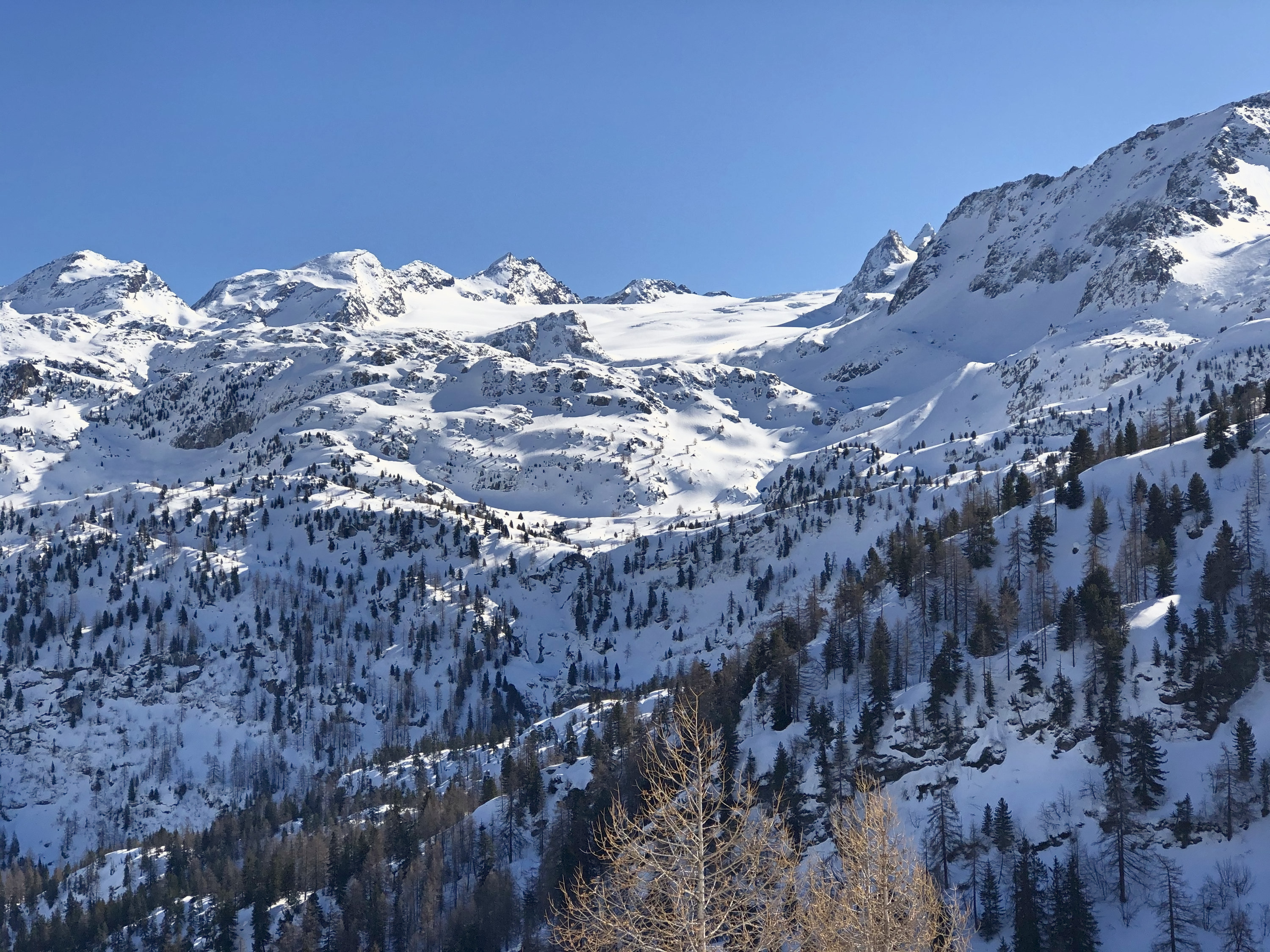
From Val d'Isère you look south-east and the border is right there, a col away. Behind it opens Valgrisenche, the wildest of the Aosta valleys, so little built on and so well snow-covered that people call it the Little Canada of the Alps. It's our direct neighbour, and a different mountain altogether: quieter and wilder, with cold snow that stays good for days on end.
That's the whole idea of a day's heliskiing in Valgrisenche starting from our door. You leave Val d'Isère in the morning, cross to the Italian side, and land on slopes few skiers ever see: a closed valley, a dam, a few stone hamlets, and above them peaks rising past 3,400 metres, with the bowls to yourselves. The mountain as it was before the lifts.
See all our heliski formats · Tell us your dates
Link long lines from morning to the last pick-up
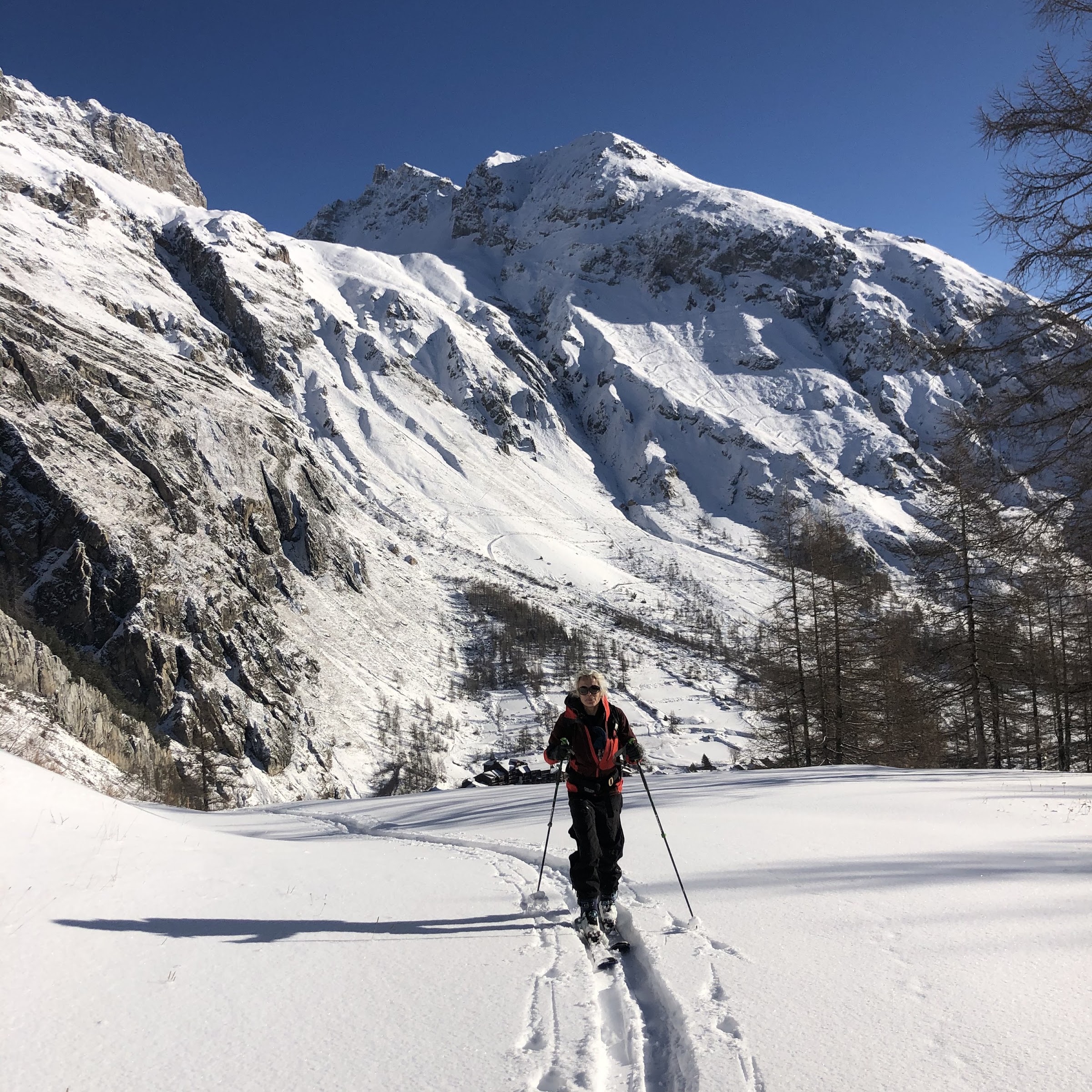
We start by kitting up, unhurried: avalanche airbag pack, transceiver, shovel and probe, all checked, transceivers tested for send and receive well before the first flight. With the Aosta Valley bulletin, yesterday's observations and the wind in mind, the guide picks the opening sector, and the helicopter carries you up to the first drop.
From there the day flows: a long descent to the pick-up point, a short flight, a fresh slope. In Valgrisenche the lines are generous, from 800 to nearly 1,900 metres of vertical, and linking them is a day to savour with solid technique. Lunch is taken in the sun, often near a baita (a stone alpine hut) or a refuge, with the best the valley has to offer: fontina, a hot dish, an espresso.
Long afterwards you remember the stone hamlets far below, the dam a sliver of ice, and your own track through untouched powder.
From the Becca di Tos couloir to the Bezzi plateaux: seventeen sectors
Heliskiing in the Aosta Valley finds some of its finest ground in Valgrisenche. Seventeen sectors are mapped here, around landmark peaks such as the Becca di Tos, the Grande Traversière (close to 3,500 m) and the Rutor massif, shared with La Thuile. From the long, sustained couloir of the Becca di Tos to the gentle plateaux around the Bezzi refuge, there's enough to keep a guide busy all season.
Exact drop points stay with the operators, and with us: the line is chosen that morning, for the snow of the day. The heights and verticals below are the recorded figures for each sector's routes, while the guide shapes the real programme around the snowpack and the weather window, and that is the charm of a day in the mountains.
From Val d'Isère, heliski at La Thuile and heli skiing at Courmayeur also make a fine day out; heli skiing at Cervinia, heliski at Monterosa, heliski at Sestriere and heli skiing at Zermatt call for a stay.
How we price a day in Valgrisenche
Every Valgrisenche day is made to order, and its price follows: the rotations flown (and with them the vertical), how many skiers you are, and the road or air transfer from Val d'Isère.
Send us your dates, your group and how much skiing you'd like, and our quote comes back within 24 hours.
Ski the signature sectors of Valgrisenche
Each of these sectors covers a stretch of mountain with its own landmark peaks, character and caveats. The figures below are those recorded for each sector's lines; the guide builds the day by the snow, in the order it suggests.
Becca di Tos, the great classic. Drop at around 3,300 metres for a descent of about 1,900 metres, facing north to north-west: the biggest vertical in the valley, a gully and sustained slopes finishing in the forest. Advanced to expert terrain. The exact drop point is chosen by the guide, by the conditions.
Giasson (Becca di Giasson), the powder that keeps late. The best-known descent in Valgrisenche: drop at around 3,200 to 3,300 metres for some 1,500 metres of vertical, due north, the aspect that holds the powder late into the season. Several variants, finishing towards Usellières or at a high baita if you shorten it. Intermediate to advanced.
Rabuigne (Alta and Bassa), one of the majors. High drop at around 3,400 metres, facing north to north-west, with a panorama over the Becca di Tei; about 1,600 metres of vertical on the upper, harder line, or 1,300 metres on the lower one. Back towards Usellières, or via the Chalet de l'Epée on the shortened variant. The high drop point stays confidential.
Château Blanc, the lookout. Drop at around 3,300 metres at the foot of the small Château Blanc glacier, often skied as the first rotation; the vertical runs from 850 to 1,900 metres depending on the line and the aspect (south, south-west or north-east). A wide panorama. Worth knowing: the sector is also skied on a ski-touring day from Planaval, and the guide keeps the two uses apart according to the day.
Feluma (Punta Feluma), the opener. Drop at around 3,000 to 3,200 metres, about 1,600 metres of vertical, north-facing to variable. A sector listed by the operators, with limited public data: to confirm with the guide against the day's conditions.
Rutor (Ruitor), the emblematic massif. Straddling La Thuile and Valgrisenche, drop at around 3,200 metres for 1,300 to 1,600 metres of descent, on terrain that can turn glaciated depending on the line. The valley's landmark summit, kept for good conditions and the guide's judgement.
Seventeen sectors are recorded in all, from the Ormelune, best skied in the morning, to the gentle plateaux of the Colle Traversière near the Bezzi refuge. Some lines, like the Cime di Fos, carry an explicit avalanche warning in the sources: we ski them only with a guide, in stable conditions.
A day in the valley, flight by flight
Morning. We meet at the base, the kit is shared out and tested, and the guide talks through the snow and the sector he has in mind before the first flight lifts off.
The rotations. Drop, long descent, pick-up, and up again to the next sector, as many times as the group's form and the weather window allow.
The vertical. The recorded lines in Valgrisenche run from 800 to nearly 1,900 metres a descent. Linking several of them is best enjoyed with solid technique in every kind of snow, and we talk it through together at booking.
Lunch. A pause in the sun near a baita or a refuge, with fontina, a warm dish and an espresso before the next flight.
End of the day. A last descent, the final pick-up, and the short trip home over the col to Val d'Isère.
Your pick-up points, at the foot of each line
In Valgrisenche each descent finishes at a pick-up point at the foot of the line, and the heli leaves from there. The valley's landmarks follow, given without coordinates; the guide sets the shuttle by the sector and the snow.
Bonne, the village at the head of the valley, the valley's reference base and the anchor point of the day.
Usellières, the natural finish for the big north descents: Giasson, Rabuigne and the Cime di Fos all run out here.
Chalet de l'Epée, the reference point when Rabuigne or Fos is shortened, higher up the bowl.
Bezzi refuge, the landmark for the Colle Traversière sector, on the side of the big plateaux and the French border.
Other finishes exist depending on the line: Planaval at the foot of the Château Blanc, a baita at around 2,200 metres for the shortened variants, or the valley road for the lower routes. The detail is settled in the morning, sector by sector.
A day built around safety
Heliskiing here means unpatrolled slopes in high-mountain terrain, and safety is the foundation on which the whole day rests.
The kit, tested on the ground. An avalanche airbag pack, a transceiver, a shovel and a probe for each skier: it is all handed out before the first flight, transceivers tested for send and receive, and tested once more if the group flies in several rotations.
The snowpack, read every morning. The guide reads the Aosta Valley avalanche bulletin alongside his own observations and the week's history, then settles on a sector. Yesterday's good slope may read quite differently today, and in Valgrisenche we keep a few sensitive lines for a narrow window.
A guide who knows when to stop. With high avalanche danger or a short window, the guide scales the day back, moves to another sector or keeps the helicopter waiting. That judgement is what you are booking, on every kind of day.
The guiding. A mountain guide is in charge of the day, as this terrain requires. Heliskiing is legal in Italy and banned in France, and Valgrisenche sits just across that line from Val d'Isère.
> This is open mountain, unmarked and unpatrolled. The kit and the guide reduce and manage the avalanche risk, which remains part of the mountain. The snow, the weather and the visibility may shorten, shift or cancel a day at any moment; we follow their lead, always.
Hop over the col from Val d'Isère
You stay in Val d'Isère and ski Italy for the day: we organise heliskiing in Valgrisenche from Val d'Isère as a day out, and being next door counts, since Valgrisenche is the closest Aosta valley to us.
Two ways to reach the valley.
- By minibus · a short drive to the base on the Italian side, simple and flexible.
- By helicopter · a hop over the col for an earlier start on the snow, when the day and the group suit it.
The choice is made with you at booking, with the group, the forecast and your appetite for skiing in mind, and the price reflects the rotations, the group size and the transfer.
From us · the base in Valgrisenche, the guide, the safety kit and the day's timing. From you · skis and boots (wide freeride skis work best; hire is easy), mountain clothing, and a picnic or a refuge stop.
When to come: north faces in winter, corn in spring
Heliskiing in Italy is a matter of snow cover and a good weather window. Valgrisenche is rich in north-facing sectors, which hold the coldest, lightest snow through the heart of winter and keep the powder late on slopes like Giasson; early spring brings corn to the south faces, best taken as the overnight freeze relents.
The valley stays wild and quiet, which is its strength, and the heli waits for clear air before it flies. Our dates keep a little give, and should the window close, off-piste skiing in Val d'Isère makes a fine alternative.
Safety, first and always. Every heliski line in Valgrisenche runs through unmarked, unpatrolled high-mountain terrain. Avalanche airbag pack, transceiver, shovel and probe are issued and tested before each flight, the guide follows the bulletin and the snowpack from one day to the next, and we adapt or postpone whenever conditions call for it. Preparation, a good read of the terrain and the decision to turn back keep that risk in hand. The valley lies in Italy, where the law allows heliskiing.
FAQ
Where is Valgrisenche, and why go there from Val d'Isère?
Valgrisenche is a valley in Italy's Aosta Valley, just over the border from Val d'Isère: it's the closest Aosta valley to us. Wild, barely built on and well snow-covered, it's known as the "Little Canada of the Alps". You ski a heliski day there and you're back in the evening.
Is heliskiing legal in Valgrisenche?
Yes. Italy allows heliskiing throughout the Aosta Valley, Valgrisenche included, while France bans it. The valley sits just across the border from Val d'Isère, so a legal heliski day is only a col away.
Which are the signature sectors of Valgrisenche?
The Becca di Tos is the great classic, with close to 1,900 metres of vertical; Giasson is the best-known descent, prized for powder that keeps late on its north face; Rabuigne, Château Blanc and the Rutor complete the picture. Seventeen sectors are recorded in all. The guide chooses on the morning, by the snow.
Who is heliskiing in Valgrisenche suited to?
Confident off-piste skiers, comfortable in powder and spring snow on sustained slopes, with the stamina for long descents: some lines run past 1,800 metres of vertical. It's a day for skiers already at home off-piste.
Can we reserve particular lines in Valgrisenche?
No, and for good reason: drop points stay flexible, and the guide builds the programme that morning around the snow and the weather, picking from the valley's sectors the aspects in best condition.
How long is the trip from Val d'Isère to Valgrisenche?
By minibus or by helicopter, agreed with you at booking. Valgrisenche being the closest Aosta valley, either way the journey is short.
How much does a heliski day in Valgrisenche cost?
On request: rotations, group size and transfer together decide the figure. Tell us your dates and plans, and our quote follows within 24 hours.
Shall we cross the col together?
We ski the valley next door whenever the snow and the weather allow, so tell us when you're coming and how many of you there are, and we'll reply within 24 hours.