Heliskiing in Italy · Monte Rosa massif · Alagna, Gressoney, Champoluc · as a stay from Val d'Isère
Heliskiing at the foot of Monte Rosa's 4,000-metre peaks: ski from Alagna, Gressoney or Champoluc
One of the few areas of the Alps where you're dropped above 4,000 metres, on the Monte Rosa glaciers, for 2,000 to 3,000 metres of descent to the valley floor, day after day, on a stay at the foot of the massif.
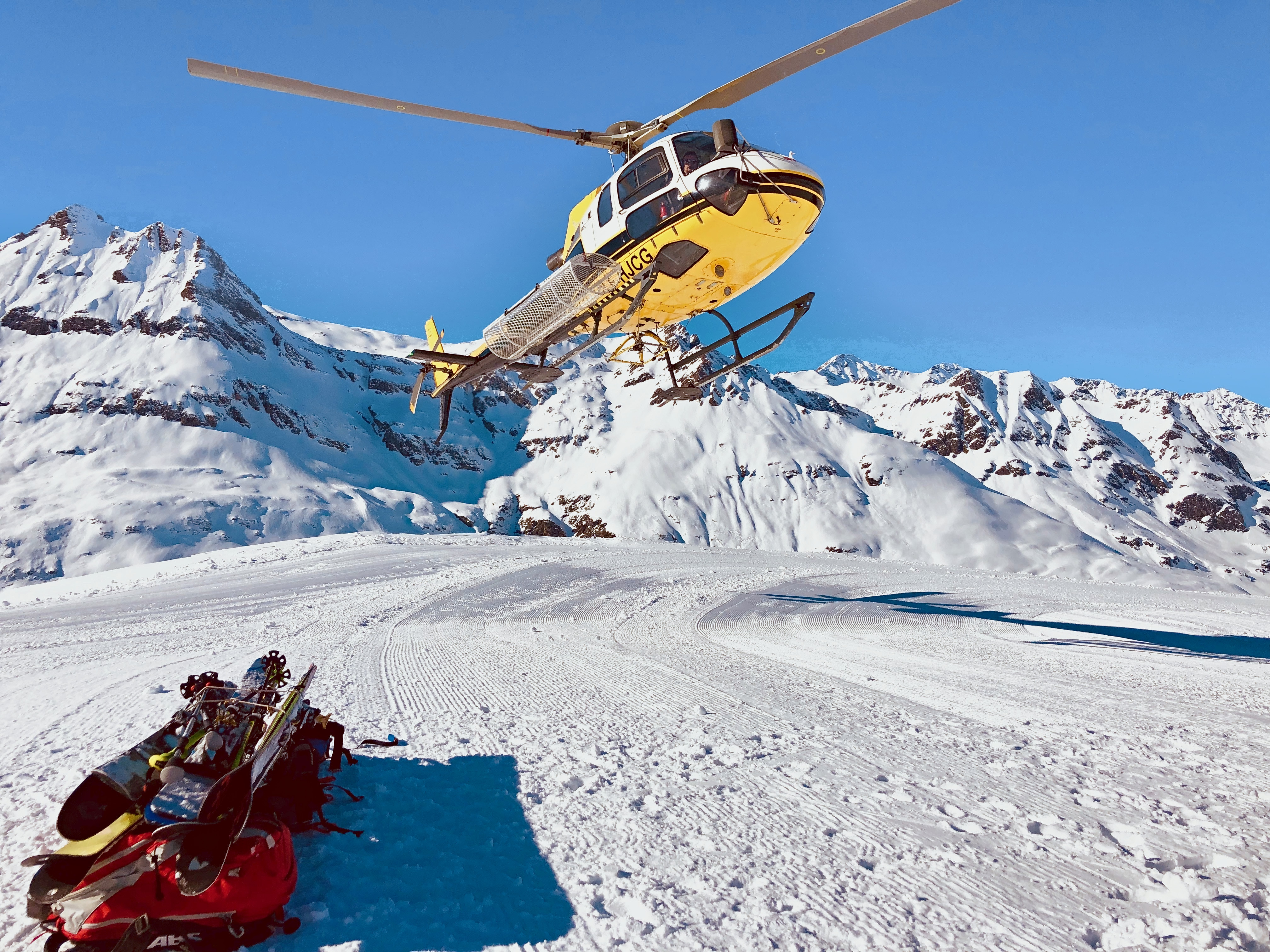
In brief
- Where
- the Monte Rosa massif: Gressoney and Champoluc on the Aosta Valley side, Alagna on the Piedmont side (Valsesia)
- Terrain
- more than 20 official drop points on record, more than 60 descents, the highest base in our range (starting at around 2,100 m)
- The top tier
- glacier drops up to 4,360 m, descents of 2,000 to 3,000 metres, up to 4,000 m of vertical on a good day
- Level
- from a good, self-sufficient off-piste skier (Bettolina, Testa Grigia sectors) to an expert high-mountain skier (Colle del Lys, Porta Nera); glacier kit a must on the high drops
- Guiding
- a mountain guide, who tightens the guiding on glacier terrain: avalanche airbag pack, transceiver, shovel and probe provided; rope and glacier kit according to the terrain
- Format
- a destination for a stay rather than a single day from Val d'Isère, organised over several days
- Price
- on request, built on the rotations, the group size and the length of stay
- Season
- midwinter for cold snow; the big glacier terrain reads better once the snowpack settles
The high mountains in full, on Monte Rosa
Most Alpine drops sit around 3,000 metres; heliskiing on Monte Rosa goes a storey higher, onto the glaciers of the massif, the highest in the Alps after Mont Blanc, above 4,000 metres. It's the top tier of our heliskiing, kept for skiers who want the high mountains in full.
You reach the massif through three gateways. Gressoney and Champoluc, on the Aosta Valley side, open the amphitheatre of the big glacier cols. Alagna, on the other flank, in Piedmont's Valsesia, leads to the wildest routes, the ones that drop towards the Italian face of Monte Rosa. Each base gives you a different mountain, and over a stay of several days on the spot the guide has time to pick his windows and his aspects.
See all our heliski formats · Tell us your dates
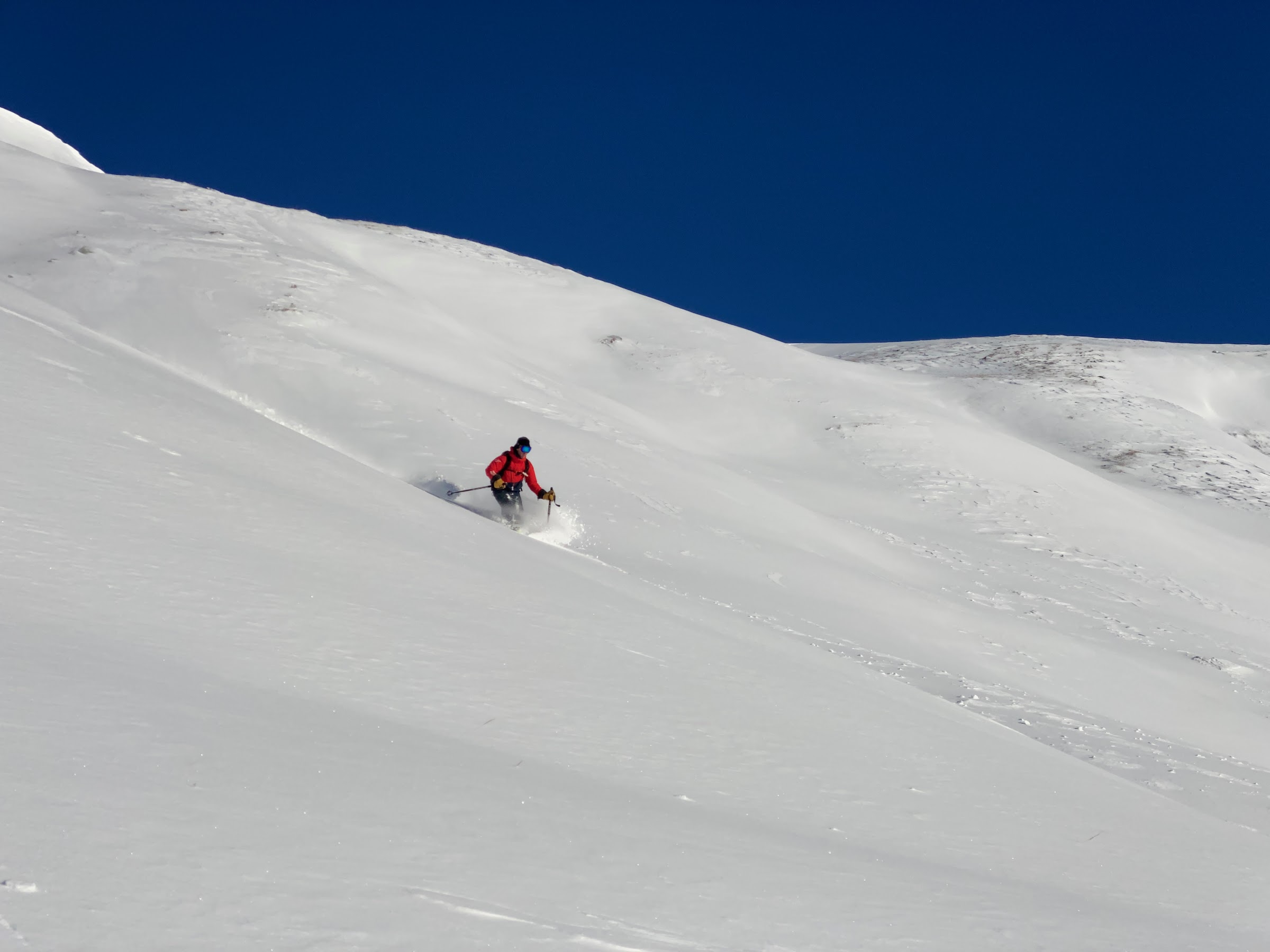
Two thousand metres in a single run: your day on Monte Rosa
Before the first flight everyone is kitted out with an avalanche airbag pack, a transceiver, a shovel and a probe, and each transceiver is tested for send and receive. Depending on the planned drop we add glacier kit (harness and rope), because at this altitude every step off the skids is chosen with care. The guide weighs the bulletin against his observations, settles on the first sector, and the helicopter lifts off.
After that, you ski big. A rotation here means 2,000 and sometimes 3,000 metres of descent, from a glacier col to a valley floor. On a good day you can come close to 4,000 metres of vertical in all. That's a volume rare anywhere in the Alps, and it calls for real ease in the high mountains. On the big sectors (the Colle del Lys, the Porta Nera, the Alagna routes) the guide keeps everyone close: reading the crevasses, roping up when needed, the route chosen metre by metre. The terrain calls for that care.
Then comes the moment you'll remember: a col above 4,000 metres, the heli already a speck over the valley, and two kilometres of untracked vertical waiting beneath your skis.
Climb the scale, from the Bettolina to the Colle del Lys
Heliskiing on Monte Rosa reads as a progression, from the most accessible to the most committing. At the lower end, sectors such as the Colle Superiore Bettolina or the Testa Grigia (the latter even offering a line skiable on a snowboard) give fine high-altitude skiing at a more forgiving level than the big glacier routes. At the top, the Colle del Lys at 4,248 metres and the Porta Nera belong to another world: true glacier, real commitment, glacier kit and rope a must, terrain reserved for expert high-mountain skiers.
The massif's operators list more than twenty official drop points and keep their precise coordinates in-house, as we do: on glaciers that change from one day to the next, a landing spot belongs to the morning. What we give here are sector and col references. Each morning the guide settles the programme by the snowpack, the state of the glaciers and the weather window. On terrain like this, reading the morning is the heart of a guide's work.
For a single day from Val d'Isère, heliski at Valgrisenche, heliski at La Thuile and heli skiing at Courmayeur are closer; heli skiing at Zermatt, on the Swiss side of the massif, and heliski at Sestriere are stays in their own right.
Compare with our other Italian bases · Cervinia, the Matterhorn side of the same massif
What shapes the price of a Monte Rosa stay
Every Monte Rosa stay is built to order, and its price follows the number of days and rotations (which set the vertical), the size of the group and the accommodation on the spot.
Give us your dates, your group size and the amount of skiing you have in mind, and we'll price your stay within 24 hours.
Pick from the sectors, Gressoney to Alagna
The landmarks below are map references for sectors, summits and cols. The massif has more than twenty official drop points, their coordinates kept by the operators, and the guide picks the actual landing spot each morning by the snow, the state of the glacier and the hazard. Heights and verticals come from published sources on the massif, as an order of magnitude.
Colle Superiore Bettolina, ~3,100 m, 700 to 1,400 m of descent. The way into the massif, on the Gressoney / Champoluc side: fine high-altitude skiing, a big setting already, but terrain that stays within reach of a good off-piste skier. The sector that warms up the legs. Intermediate to advanced.
Testa Grigia, ~3,315 m, 900 to 1,600 m of descent. A big, accessible classic, with a line often cited as skiable on a snowboard, rare at this altitude. Fine slopes, open views over the massif. Advanced.
Roisette, ~3,334 m, 1,000 to 2,000 m of descent. A drop that unrolls a long vertical on the Champoluc side, good varied skiing down to the valley floor. Advanced.
Quintino Sella refuge, ~3,585 m, 1,000 to 1,800 m of descent. A higher drop, at the foot of the big routes, where the high mountains begin in earnest. Advanced to expert.
Ghiacciaio del Felik / Col Felik, ~4,060 m, 1,500 to 2,200 m of descent. Into pure glacier terrain: a drop above 4,000 metres, crevassed ground, closer guiding. Glacier expert.
Colle di Verra, ~3,850 m, 1,400 to 2,200 m of descent. A big glacier col, the gateway to the most committing routes on the Aosta side. Glacier expert.
Porta Nera / Schwarz glacier, ~3,750 m, 1,900 to 2,600 m of descent. A major glacier route, often reached via the Colle del Lys or the Colle di Verra, with a very long vertical and real high-mountain commitment. Glacier expert.
Colle del Lys / Lysjoch — 4,248 m, 2,400 to more than 3,000 m of descent. The massif's signature col, above 4,200 metres: one of the longest glacier descents in the Alps, and the gateway to the crossing towards Zermatt. Pure high-mountain terrain, glacier kit and rope a must. Glacier expert, the top of the scale.
Cavallo / Resegotti, ~3,400 m, ~2,200 m of descent, Alagna side. Below the Resegotti bivouac, one of the great wild routes on the Piedmont side, back down to Alagna. Expert.
Valle delle Locce, ~3,300 m, 1,500 to 2,200 m of descent, Alagna side. An isolated glacial valley, in the wildest setting on the massif. Expert.
Passo dei Salati / Punta Indren access, ~3,275 m, 700 to 1,800 m of descent. The threshold between the Valsesia and the Lys valley, where the two flanks meet, skied both as freeride and from a drop. Advanced to expert.
The high Monte Rosa glacier drops, up to ~4,360 m. In the best conditions the massif allows very high drops, above 4,000 metres, for descents of 2,000 to 3,000 metres and more. It's the most alpine terrain in our range, strictly for expert skiers, subject to conditions and permissions. Glacier expert.
From this list the guide draws a few sectors each day, chasing the best snow and the soundest glacier.
Alagna, Gressoney or Champoluc: three bases, two flanks
You ski the massif from three bases, on two distinct flanks. That's what lets us build a real stay rather than a one-off day.
Gressoney (Aosta Valley side). The gateway to the big glacier cols: Colle del Lys, Colle di Verra, Col Felik. On the good days, the well-known crossing towards Zermatt starts from here.
Champoluc (Aosta Valley side). Gressoney's neighbour in the linked Monterosa ski area, it opens the Testa Grigia, Roisette and Bettolina sectors, the best way in for a group stepping up.
Alagna (Piedmont side, Valsesia). On the far side of the massif, in a valley known for wild freeride. The routes there are more isolated (Locce, Cavallo, Resegotti) and drop towards the Italian face of Monte Rosa.
Gressoney and Champoluc are in the Aosta Valley; Alagna is in Piedmont, in the Valsesia. Three villages, one massif, but two regions and two characters of mountain.
The Zermatt crossing, when the mountain allows
It's the route skiers dream about and the one you hear about most: from Gressoney or Alagna, a drop at the Colle del Lys or on the high glaciers, then a long descent that crosses onto the Swiss side and reaches Zermatt.
It's real, and it's superb. It's also a long glaciated high-mountain route that depends on conditions and visibility. It happens when the snow, the stability of the snowpack and the weather window line up, with a mountain guide, and the decision is made on the day. We mention it because it belongs to the massif's story, with every caveat it deserves.
The rhythm of a Monte Rosa day, from first flight to last pick-up
Morning. We meet, hand out and check the safety kit, add glacier kit for the planned drop, and the guide briefs the group on the snow and the sector he has chosen. Then the first flight takes you up for the first drop.
The rotations. Each rotation links a glacier drop, a long descent of 2,000 to 3,000 metres to a valley floor, then a new flight. The volume builds quickly: a good day can come close to 4,000 metres of vertical.
On the glacier. On the big cols (Colle del Lys, Colle di Verra, Porta Nera) the guide keeps the group close, reads every crevasse, ropes up where needed and lets the terrain set the pace.
Lunch. Between two aspects, we often drop to a refuge or a village. Italian mountain cooking does the rest: a warm dish, an espresso, and back to the heli.
End of the day. A final run, the last pick-up, and back to the stay's base, with the longest descent of your winter still replaying.
Guiding and glacier kit, for safety up high
Heliskiing on Monte Rosa takes place on unpatrolled high-mountain glaciers. Here more than anywhere, safety shapes every decision of the day.
The kit, checked before every flight. Avalanche airbag pack, transceiver, shovel and probe go to every skier. Everything is handed out before the first flight, each transceiver checked for send and receive, with a fresh check whenever the groups change.
Glacier kit, on top. On the high drops (Colle del Lys, Col Felik, Porta Nera, the Alagna routes) we add glacier kit: harness, rope, what's needed to rope up and move across crevassed ground. The terrain requires it, and it comes as standard.
Living glaciers. Skiing Monte Rosa means skiing glaciers that move, with their crevasses and snow bridges. The guide reads each snow bridge and lays the track along the soundest line, roped up where it counts. That care is what turns a big glacier into a great day.
The snowpack, read every morning. Each morning the guide compares the avalanche bulletin (the Aosta Valley bulletin for Gressoney and Champoluc) with his own observations and the week's record, and only then picks a sector. Every col is read afresh each morning, whatever it gave the day before.
Choosing the moment to turn back. On this terrain, deciding when to stop is the guide's most valuable call. If the avalanche danger is high, the glacier hard to read or the window too short, we change sector, scale back, or wait for a better day. That judgement is what makes the big days possible.
The guiding. Every day on these glaciers is led by a mountain guide, the qualification the terrain requires. Italian law permits heliskiing, which France bans, and that is what lets us organise Monte Rosa as a stay from Val d'Isère.
> Up here every slope is unmarked, unpatrolled glacier terrain. Kit and guiding temper the avalanche risk and the crevasse hazard, and keep them under constant watch. Snow, weather and visibility can cut a day short, move it or cancel it at any moment, and up here we let them have the last word.
Settle in at the foot of the massif: logistics and accommodation
We ski Monte Rosa as a stay: the distance, the altitude and the scale of the mountain call for several days on the massif itself, settled in at its foot.
The format. We organise heliskiing on Monte Rosa as a stay of a few days, with accommodation at the foot of the massif, on whichever side best serves the programme (Gressoney, Champoluc or Alagna depending on conditions and your plans). That gives the guide time to pick his weather windows and build a real, unhurried run of days.
We take care of · liaison with the base in Italy, the mountain guide, the safety and glacier kit, the accommodation and the rhythm of the stay. You bring · your own skis and boots (ideally wide freeride skis; hire can be arranged), your high-mountain clothing, and the fitness to enjoy long days at altitude.
The price is built on request: number of days, number of rotations, group size, accommodation.
When the glaciers and the weather line up
Heliskiing in Italy rests on three things up here: the snow cover, the state of the glaciers and the weather window. In midwinter the coldest snow lies on the north-facing slopes and on openers like the Bettolina or the Testa Grigia. The big glacier routes (Colle del Lys, Porta Nera, the high Monte Rosa drops) often read better once the snowpack settles and crevassed terrain becomes more predictable.
At this altitude everything hangs on visibility and stability: the helicopter and the glacier both need clear air. That's why we favour the stay format, which multiplies the windows, and why we always keep a fallback (off-piste skiing in Val d'Isère or a lower base) if the big terrain closes.
Safety on Monte Rosa. Heliskiing on Monte Rosa takes place on high-mountain glaciers, unmarked and unpatrolled. Each flight starts with the safety kit handed out and tested (avalanche airbag pack, transceiver, shovel and probe), with glacier kit added on the high drops; on the glacier the guide keeps the group close, tracks the bulletin and the snowpack daily, and reshapes or postpones the day whenever conditions demand. The avalanche risk and the crevasse hazard are managed through preparation, a patient read of the glacier and the decision to turn back, with the kit as the first line. Heliskiing is lawful on both Italian flanks of the massif, Aosta and Piedmont alike.
FAQ
Is heliskiing legal on Monte Rosa?
Yes. Heliskiing is permitted in Italy, on the Aosta Valley side (Gressoney, Champoluc) as on the Piedmont side (Alagna), whereas France bans it. Organising it from Val d'Isère therefore means a stay on the Italian side, fully within the law.
What level do you need for heliskiing on Monte Rosa?
It depends on the sector. The Bettolina or the Testa Grigia stay within reach of a good, self-sufficient off-piste skier. The big glacier cols (Colle del Lys, Porta Nera, Col Felik, the Alagna routes) call for an expert level and real high-mountain experience, with rope and glacier kit. Monte Rosa is the most committing tier of our heliskiing.
How high does the helicopter drop you on Monte Rosa?
In the best conditions the massif allows glacier drops above 4,000 metres, up to around 4,360 m on the high Monte Rosa glaciers. That's what makes descents of 2,000 to 3,000 metres possible, among the longest in the Alps. These high drops are for expert skiers only, subject to conditions and permissions.
Can you ski down to Zermatt from Monte Rosa?
The massif's programmes list the route: from Gressoney or Alagna, a high drop then a long descent that drops away towards Zermatt. It's real, and it's glaciated high-mountain terrain that depends on conditions and visibility. It's done with a mountain guide when the snow and the weather line up, and decided on the day itself.
Can you ski Monte Rosa as a day trip from Val d'Isère?
No. The distance, the altitude and the scale of the massif call for a stay of several days on the Italian side. That gives the guide time to pick his weather windows and build a real run of days, far better than a rushed there-and-back.
Are Alagna, Gressoney and Champoluc on the same massif?
Yes, Monte Rosa, but two flanks and two regions. Gressoney and Champoluc are in the Aosta Valley; Alagna is in Piedmont, in the Valsesia. Each side has its own character, and a stay can draw on both.
Are the descents fixed in advance on Monte Rosa?
No. From the massif's twenty-plus official drop points, the guide picks on the morning itself, according to the snow, the state of the glacier and the weather, the ones whose aspects hold that day, which keeps you on the best and soundest snow.
How much does a heliski stay on Monte Rosa cost?
It's quoted on request, reflecting the number of days and rotations, the size of the group and the accommodation. Tell us when and how you'd like to ski, and we'll come back with a quote within 24 hours.
Let's plan your stay on Monte Rosa
Monte Rosa calls for several days at the foot of its 4,000-metre peaks, so let us know your preferred week and the size of your party, and your quote for the stay follows within 24 hours.