Heliskiing in Italy · Aosta Valley · Rutor massif · organised from Val d'Isère
Heliskiing at La Thuile: ski the Rutor glacier, then lunch in Italy
Ski big glacial descents off the Rutor from a base straddling the Little St Bernard, and savour the best of Aosta Valley cooking at midday. Avalanche airbag pack, transceiver, shovel and probe provided.
In brief
- Where
- La Thuile, Aosta Valley: the Rutor massif, the Italian flank of the Little St Bernard, within reach of La Rosière via the Espace San Bernardo
- Terrain
- eight mapped sectors, from the Rutor glacier to the Breuil peaks, descents of 1,000 to 1,800 m of vertical
- The signature
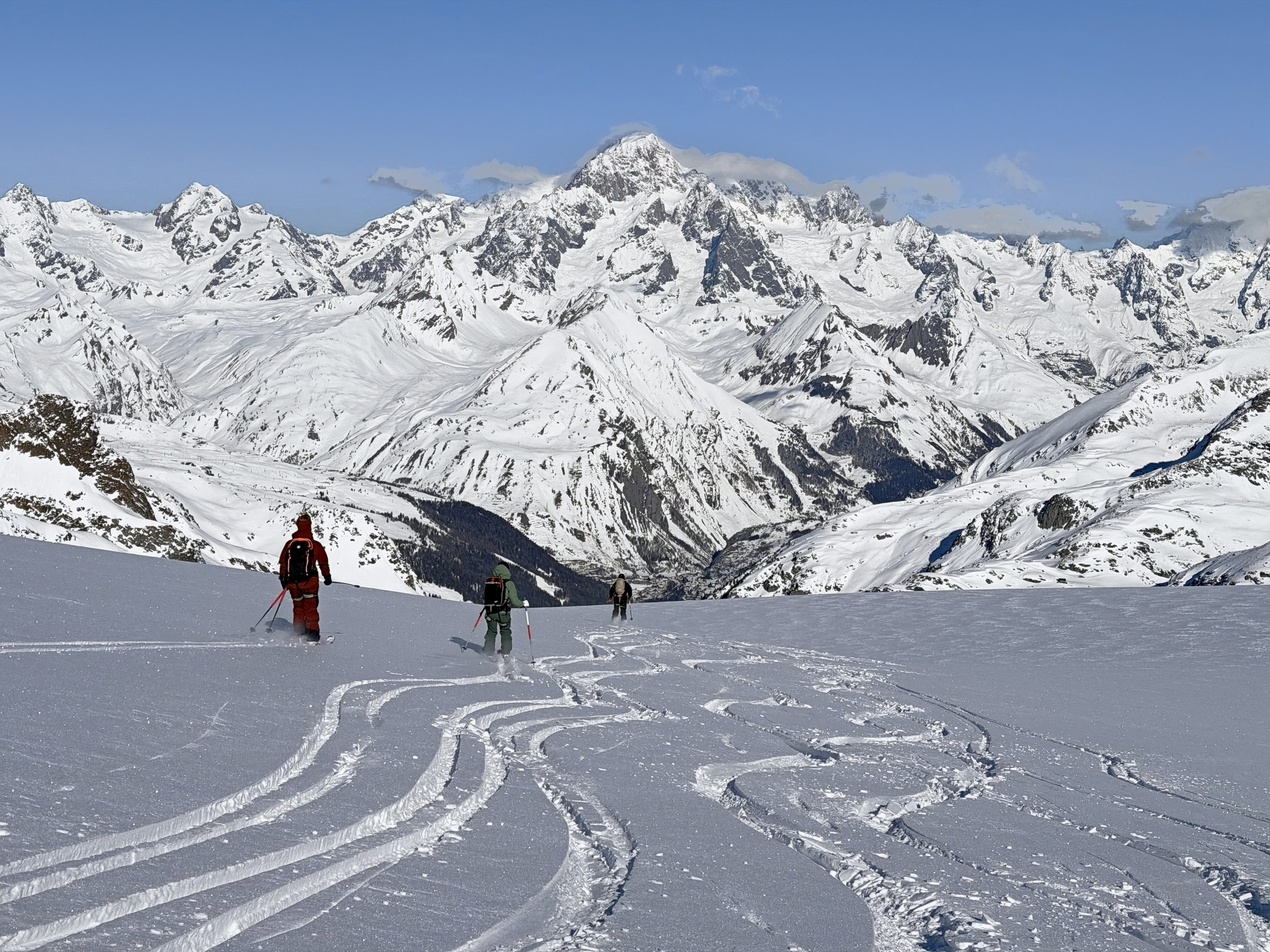
- the Rutor glacier, one long descent in a single sweep facing Mont Blanc
- Level
- from a solid intermediate to a strong off-piste skier depending on the sector; the Rutor calls for real confidence in high-mountain terrain
- Group
- private or a small tailored group; the helicopter carries up to four skiers per rotation
- Safety kit provided
- avalanche airbag pack, transceiver, shovel and probe, checked before every flight
- Guiding
- mountain guide, the qualification glaciated terrain requires
- Departure
- from Val d'Isère for the day, timed to suit the group
- Price
- on request: the rotations, the group size and the transfer decide it
- Season
- usually January to April, sometimes later on the glacier, snow and weather window permitting
We organise heliskiing at La Thuile from Val d'Isère: heliskiing is legal in Italy, so we cross the Little St Bernard to the foot of the Rutor massif, on the Italian side, for a day fully within the law. The drop is on the glacier, the descent runs to some 1,800 metres facing Mont Blanc, and a few lines finish back down towards La Rosière. Avalanche airbag pack, transceiver, shovel and probe provided, a mountain guide, and the sector chosen that morning to match the snow. Midday belongs to Aosta Valley cooking.
The price is on request, built around the rotations you fly, the size of the group and the transfer.
Preparation first, then judgement on the day
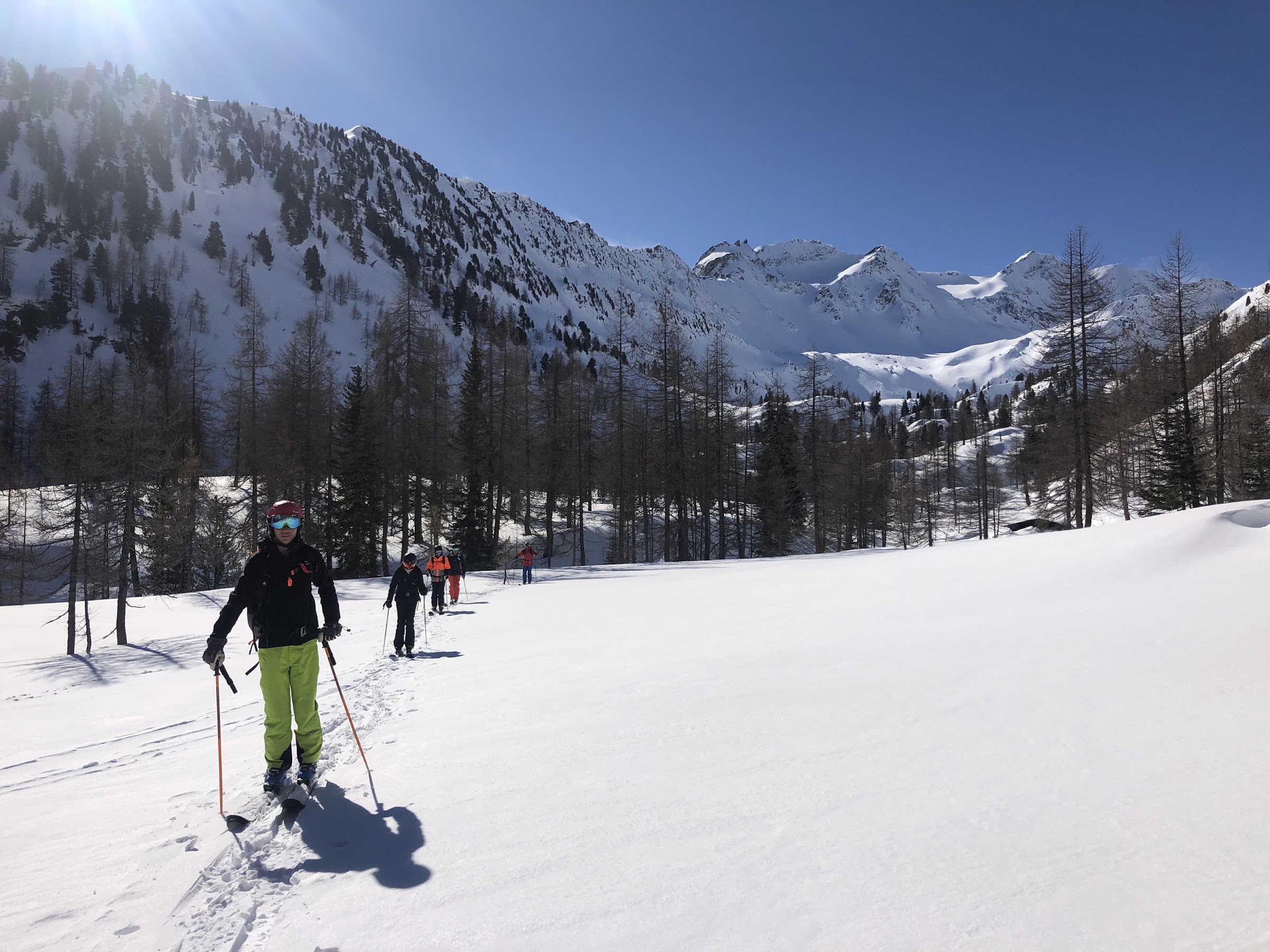
Heliskiing takes place on unmarked, unpatrolled terrain, in the high mountains and on the glacier. Before every flight the safety kit (avalanche airbag pack, transceiver, shovel and probe) is handed out and tested. The guide keeps a daily eye on the avalanche bulletin and the snowpack, and each day is adapted or postponed whenever conditions call for it. The kit is only the start: what keeps you safe is preparation, a close read of the terrain and the readiness to turn back. Every drop takes place in Italy, where heliskiing is legal.
Fly at first light, ski until the last run
The day opens with the kit: avalanche airbag pack, transceiver, shovel and probe for everyone, each transceiver tested for send and receive on the ground. Meanwhile the guide weighs the Aosta Valley avalanche bulletin, yesterday's observations and the wind, and picks the first sector; on the Rutor he adds glacier kit when the terrain calls for it. Then the helicopter lifts off for the first drop.
From then on you ski, and the heli takes you back up. Each rotation runs the same way: dropped up high, a descent of 1,000 to 1,800 metres depending on the line, a pick-up sometimes on the French side, sometimes deep in an Aosta valley, and the helicopter back for you. The Rutor glacier is often skied to open the day, while the overnight snow still holds: the big glacier first, the Breuil peaks after, according to the light and the group's legs. We match the number of rotations to how the group is going and to the weather window.
What stays with you afterwards is the silence after lift-off, the fresh track you lay on a vast glacier, and later the warmth of a mountain hut as you peel off your gloves. The mountain in the morning, Italy at midday.
Choose from eight sectors, from the Rutor glacier to the Breuil peaks
Heliskiing on the Rutor means a whole fan of aspects, running from the big glacier (Testa del Rutor, Becca Bianca) to the drier peaks over towards the Breuil and the Little St Bernard: Miravidi, Ouille, Lechaud, Freduaz. Some lines stay Franco-Italian and rejoin La Rosière; others stay within the Aosta Valley. Each is a zone of terrain rather than a fixed itinerary, with its landmark summit and its rough vertical, and on every one the exact landing spot is decided on the day itself.
- Rutor, French flank. The big signature day: a glacial start, a descent of around 1,800 metres dropping onto the French side and finishing down towards La Rosière, then the Espace San Bernardo lifts back into Italy. Solid intermediate to strong skier.
- Rutor, Italian flank. The La Thuile glacial classic, ideal for opening a day of powder: a big glacier with little exposure, a gentle first section, a steeper headwall to finish, around 1,200 metres. Intermediate level.
- Testa del Rutor (3,486 m). The high point of the massif: volume, altitude, a major glacier, views of Mont Blanc. High-mountain terrain, around 1,400 metres, for strong skiers in good conditions only.
- Becca Bianca (3,257 m). An elegant, often cold face where the snow keeps well. Around 1,100 metres, a north-leaning line, a panorama over the glacier.
- Mont Miravidi (3,066 m). The scenic, playful sector, glacier-free: broad rounded shoulders, around 1,050 metres, a steeper final gully towards the Breuil.
- Mont Freduaz (~2,835 m). The cold, efficient line, often good late in the season, straddling the border: a gentle upper section, a mid headwall where avalanche vigilance is essential.
- Mont Ouille (3,099 m) and Pointe Lechaud (3,127 m). The sunny spring-skiing sectors, with two aspects the guide times by the sun and the overnight freeze.
Each morning the guide picks from these sectors as the snow and the light suggest, from the glacier to the Breuil bowls.
Safety on the Rutor: avalanche airbag pack, transceiver, snowpack and the guide's eye
Every slope you ski here is unmarked, unpatrolled high-mountain terrain, and the Rutor adds the glacier. Safety frames every minute of the day.
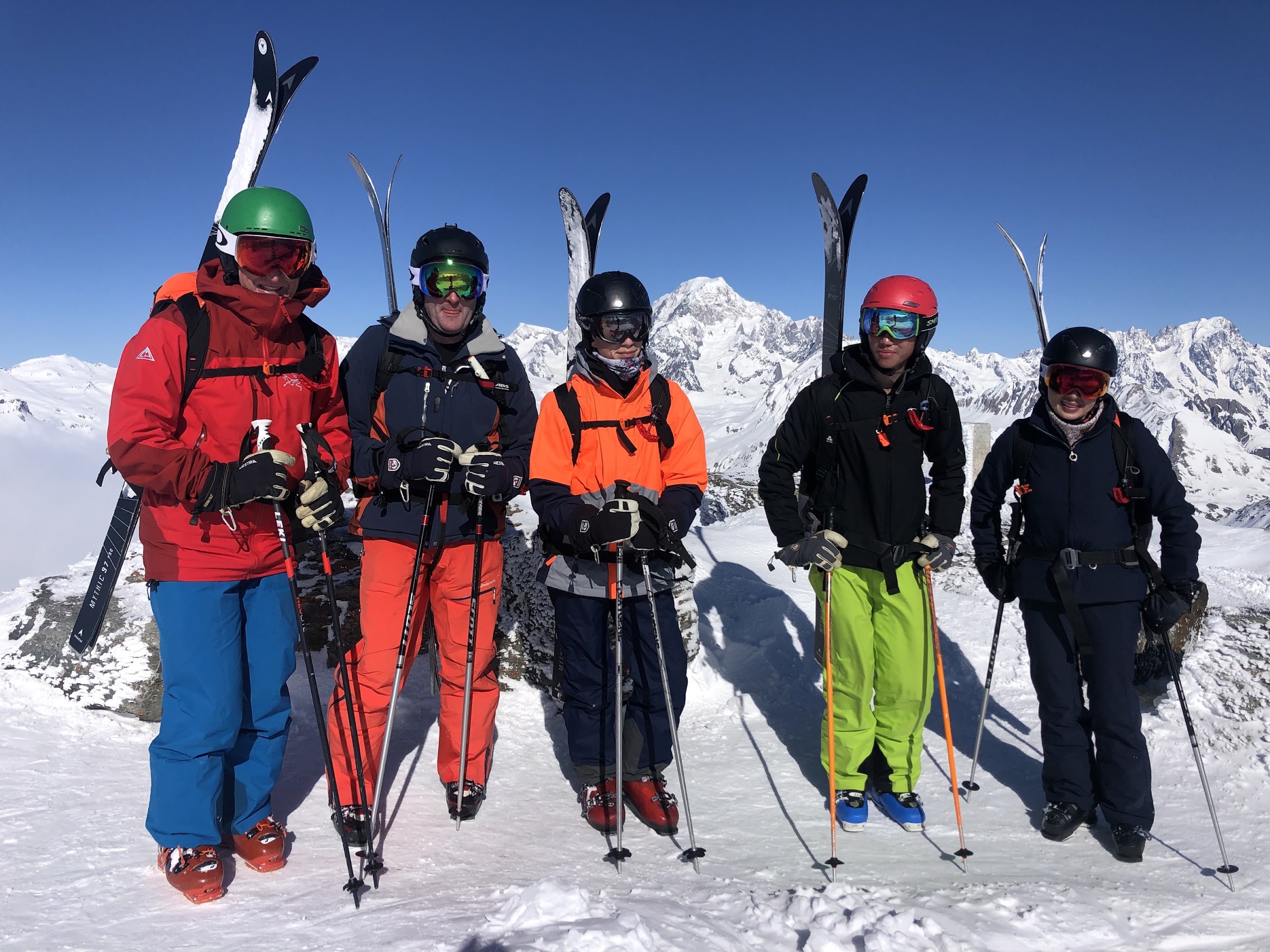
The kit, first: avalanche airbag pack, transceiver, shovel and probe for each skier, handed out before the first flight and checked one by one. It's all included in the price.
The snowpack, next: before settling on a sector, the guide sets the Aosta Valley avalanche bulletin beside his own observations and the week's history. Each slope is judged afresh every morning: the Freduaz mid headwall, or a bowl wind-loaded overnight, each asks for its own read.
When conditions shift, we adapt the day. Depending on the avalanche danger we change sector or drop altitude, or choose gentler slopes, and when the danger rises, heliskiing, like off-piste, can still go ahead on slopes below 30 degrees, well away from the dangerous slopes above. If the window is too short or the visibility poor, the helicopter stays on the ground for the day. Judging when to stop is as much a part of the craft as flying, and that judgement is what you engage us for. As for the law, Italy permits heliskiing where France bans it, which is what brings La Thuile within reach of Val d'Isère.
Set off from Val d'Isère, and be back by evening
You keep your base in Val d'Isère throughout. We organise heliskiing at La Thuile as a day out from Val d'Isère, back the same evening. The geography helps: La Thuile is on the far side of the Little St Bernard, and some Rutor lines finish down at La Rosière, within reach of the Tarentaise. Heliski at Valgrisenche and heli skiing at Courmayeur also make a fine day out from Val d'Isère; heli skiing at Cervinia, heliski at Monterosa, heliski at Sestriere and heli skiing at Zermatt call for a stay.
The transfer is arranged with you when you book, to suit the size of the group, the weather window and how much skiing you have in mind. On our side: coordination with the Italian base, the guiding, the safety kit and the pace of the day. On yours: your ski gear, your mountain kit, and your lunch, on the mountain or at a hut.
The same valley also makes a fine ski-touring day, at an altogether different pace: our La Rosière / La Thuile day explores it on skins, a separate outing described on the off-piste day-trips page.
Midwinter powder or spring corn on the Rutor
Everything depends first on the snow cover and the weather window. The season usually runs January to April, and the Rutor glacier can hold later, into May in some years. Deep winter offers the coldest snow on the north sectors, Becca Bianca and Freduaz; spring brings good corn on the sunny Breuil aspects, taken just as the overnight freeze lets go.
Sunshine is something the Aosta Valley does well, and you often ski here under a clear blue sky while the French side sits in cloud. Visibility still sets the rhythm: the heli wants clear air, and the great Rutor glacier shows its best in good light. So we keep some flexibility on dates, and a fallback if the window shuts: off-piste skiing at Val d'Isère.
Pack light: what we provide, what you bring
We provide the full safety kit (avalanche airbag pack, transceiver, shovel and probe), along with the guiding by a mountain guide, and the glacier kit when the terrain calls for it. It's included in the price.
You bring:
- The skis · wide freeride skis give real comfort on the glacier. Hire is possible; we'll point you to the right waist for your level.
- The clothing · waterproof jacket and trousers, breathable layers, warm gloves, goggles, helmet recommended.
- The midday stop · lunch at a hut or by the piste, depending on the day.
We go over the kit at booking so everything's settled before the day itself.
Book your day: the price, on request
Each day is tailored, and so is its price, quoted on request: the rotations you fly decide the vertical, then come the group size and the Val d'Isère transfer.
Tell us your dates, the number of skiers and the volume of skiing you're after through the contact form or by phone, and you'll have a quote within 24 hours, in English, French or German. The full range of our formats is on the heliski page, and the school's other rates on the prices page.
A word from the founder
We've been taking skiers onto the Rutor for years: it's one of the rare big glaciers within a day of Val d'Isère, and on a good day it gives you an immense descent. You cross the border for snow with a character all its own, and you're back the same evening.
Boris Malesset, who founded PowderWeGo after directing the TopSki school in Val d'Isère, has skied off-piste professionally since 2001.
FAQ
Is heliskiing legal at La Thuile?
Yes. Heliskiing is legal in Italy, the Rutor massif above La Thuile included, while France bans it. From Val d'Isère we simply cross the Little St Bernard to ski on the Italian side.
What's the big heliski descent at La Thuile?
The Rutor glacier. From a high start, the signature line runs to around 1,800 metres of vertical, with views of Mont Blanc; some variants drop onto the French side and finish down towards La Rosière. It's high-mountain terrain, for good conditions only.
Is heliskiing at La Thuile within my level?
It depends on the sector. The Breuil peaks, like Miravidi or Freduaz, stay within reach of a solid intermediate, while the Rutor glacier and the Testa del Rutor call for real confidence in high-mountain terrain, and stamina. In every case you need to be comfortable off-piste on a sustained slope.
Can the drops be chosen before the day?
No: the guide decides that morning, by the snow, the wind and the visibility, choosing from the eight sectors the aspects that hold. That flexibility is what puts you on the best snow of the day.
Can you ski the Rutor and return via France?
Yes, on the signature line of the French flank: the descent finishes down towards La Rosière, you're picked up on the French side, then you take the Espace San Bernardo lifts back into Italy. It's one of the draws of this cross-border base, subject to the day's programme and the conditions.
Which safety kit do you provide on the Rutor?
Each skier is given an avalanche airbag pack, a transceiver, a shovel and a probe, all checked before the first flight. On the glacier, the right kit is added according to the terrain. A mountain guide leads the day. You bring only your ski gear and your mountain clothing.
How much does a heliski day at La Thuile cost?
The price is on request: every day is put together to order, shaped by how many rotations you fly, the size of the group and the Val d'Isère transfer. Tell us your dates and how much skiing you'd like, and we'll reply within 24 hours.