Your safety in the mountains · Val d'Isère
Avalanche safety in Val d'Isère: learn to read the risk as you ski off-piste with us
Val d'Isère has some of the finest off-piste in the Alps, and some of the most subtle to read. Learn how we judge the Val d'Isère avalanche risk every morning, before anyone clicks into their skis: more than twenty years of guiding this terrain, shared with you.
In brief
- Where you find the risk
- Météo-France's avalanche bulletin (the BRA), published every afternoon for the next day, Haute-Tarentaise massif
- The scale
- 1 (low) to 5 (very high): a European danger level that reads the snowpack, quite apart from the weather
- The most common danger
- the wind slab, invisible from above, which breaks under a skier's weight
- The kit
- avalanche airbag pack, transceiver, shovel and probe, carried on you and provided by the school on every outing
- The skill that saves the most lives
- knowing when to turn back, even after you've climbed
- Insurance
- costs vary with the cover you choose (FFS Carte Neige, a dedicated season policy, the option on some premium bank cards): compare policies on their rescue and medical cover rather than on price alone
- How we look after you
- bulletin read every morning, terrain chosen by the day's snow, and the freedom to turn back
What a perfect bluebird day can hide
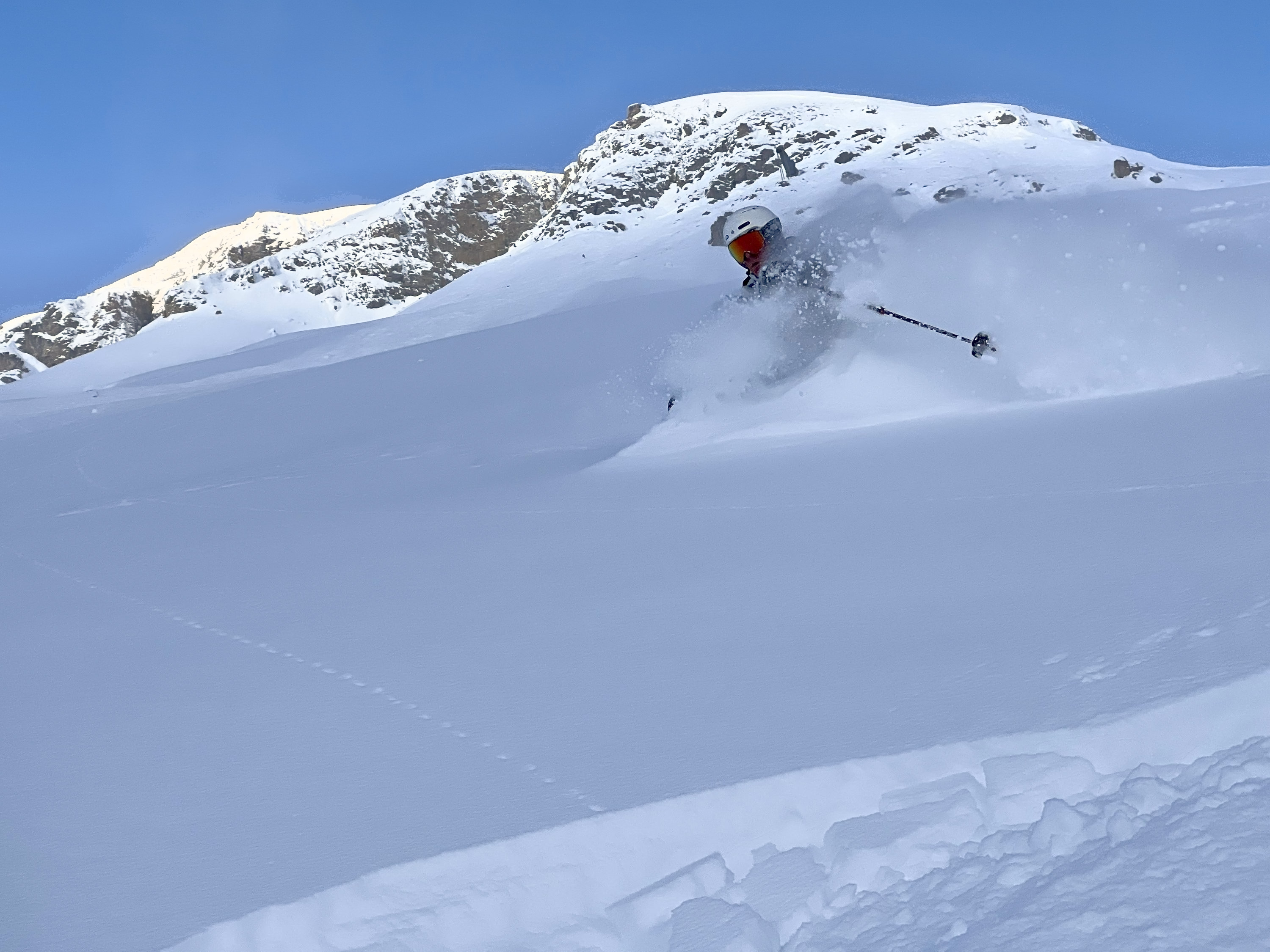
The morning after the big snowfall, the sky was a blue that made you squint. The air hung perfectly still, the valley frozen, the village asleep under fifty centimetres of fresh. Of all the mornings in a winter, this is the one where avalanche safety calls for the most care. The snow is there, perfect, and your first instinct is to charge, at the very moment the new snow is still bonding to the old.
An avalanche can release under a clear sky as readily as in a storm. It needs a slope, a weak layer buried beneath the surface, and a load: a skier's weight is enough. In Val d'Isère, the terrain that makes the off-piste so good is also the terrain that ticks every one of those boxes: steep bowls, north faces that hold unstable layers for a long time, wind that moves snow from one col to the next. Understanding that risk is what lets you keep skiing these slopes for years.
Reading the snowpack: years of study and experience
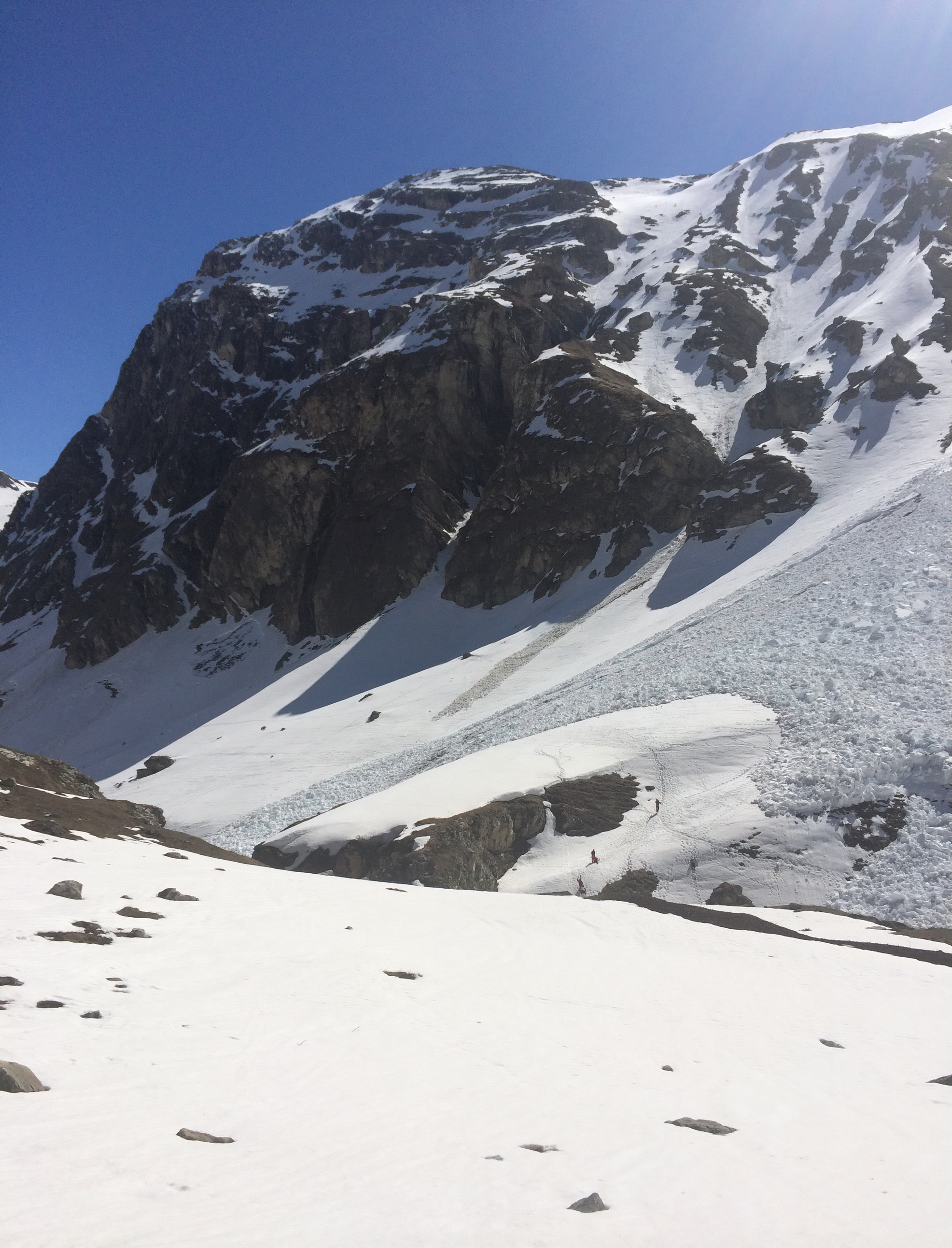
A slope's stability lies beneath the surface, well out of sight from the chairlift. Two neighbouring slopes, apparently facing the same way, can behave quite differently, one sound and the other fragile, because of a layer of depth hoar that formed three weeks earlier in a mild spell and was then buried again. Reading that story, the history of the snowpack since the start of winter, is the work of a lifetime, built season after season. How altitude and aspect shape the snow here is the subject of our Val d'Isère snow page.
What we bring you, then, is judgement. Every morning we weigh the bulletin against the night's wind, the temperature and what we saw on the ground the day before, and settle on where the day's soundest and finest snow lies.
The avalanche bulletin (BRA): read it as we do, every morning
Every afternoon, Météo-France publishes its avalanche bulletin (the BRA, bulletin d'estimation du risque d'avalanche) for the next day, massif by massif. Val d'Isère falls under the Haute-Tarentaise massif. Quite separate from the weather forecast, it is a snow-science assessment that gives you the danger level, the altitudes and aspects concerned, and the type of avalanche expected that day.
We read well beyond the number: the aspect rose (the compass dial showing which aspects and altitudes are loaded) and the text, which describes the day's problem, whether wind slab, new snow, a persistent weak layer or spring wetting. A level 3 "north above 2,400 m" and a level 3 across the board describe two very different days. We read this bulletin every morning before setting off; it's the first move of the day, before we even choose the sector. Check it yourself on Météo-France's mountain pages (in French; the danger level and the aspect rose read at a glance).
Understanding the avalanche danger scale, 1 to 5
The avalanche danger scale runs from 1 (low) to 5 (very high), and it climbs steeply: each step marks a far sharper rise in danger than a school mark would suggest, so a 3 out of 5 deserves real respect.
- 1 · Low, the snowpack is generally stable. Triggering is possible only on isolated, very steep slopes.
- 2 · Moderate, stable on most slopes; a few identifiable steep slopes remain fragile.
- 3 · Considerable, the most treacherous level. The snowpack is moderately to weakly bonded on many slopes; a single skier can trigger. Most serious accidents happen at level 3.
- 4 · High, unstable on most steep slopes; natural releases likely.
- 5 · Very high, an exceptional situation, large avalanches reaching the valley floor.
Level 3 claims more lives than level 4, because it inspires confidence. That is where reading the terrain and experience make all the difference. As the level rises, it comes down to making the right calls, matching the route to the avalanche conditions and knowing when to turn back, which is exactly what skiing with a professional is for. The full danger scale is set out by the European Avalanche Warning Services.
The wind slab, the first danger you learn to spot
Most skiers caught in an avalanche are taken by surprise, and the usual culprit is a wind slab: a cohesive layer of snow laid down by the wind on top of a weak layer. On the surface it often looks smooth, matt, a little "pillowed". Underneath, a weak layer holds it by a thread.
The wind carries snow and dumps it on lee slopes: after a night of westerly wind, it's the east- and south-east-facing bowls and rolls that load up. The slab breaks in one piece when the skier loads it, often above them, across the whole width of the slope. That's the mechanism behind the most serious accidents. Spotting a slab, feeling that hollow, drum-like sound under your skis, hearing a "whumpf" as the snowpack settles: these are signals you learn to read, and they should stop you in your tracks.
Read the terrain: pitch, aspect and traps
An avalanche needs a slope. Below 30 degrees a slab rarely releases; between 30 and 45 degrees is where most accidents happen. By eye, 30 degrees is already steep, the pitch of most of the red runs on the Val d'Isère ski map. We measure it with an inclinometer, slope by slope.
Beyond the pitch, we read the terrain traps: narrow gullies where a small slide turns deadly through sheer depth of debris, breaks in slope, the zones under cornices, the convex rolls where the snowpack is under tension. We read the aspect against the problem named in the bulletin. And we read how reachable a rescue would be and the run-out below, because surviving an avalanche starts with keeping well clear of a funnel. That continuous reading, slope after slope, is the heart of what we do for you on a guided day.
Avalanche airbag pack, transceiver, shovel, probe: the four non-negotiables
Four items, inseparable, carried on you from the first turn to the last:
- The avalanche airbag pack · triggered the moment a slide starts, it helps keep you near the surface. It is as much a part of the kit as the other three.
- The transceiver · a transmitter-receiver everyone wears switched on. If someone is buried, the others switch to search to locate them.
- The shovel · to dig. A person under a metre of packed debris means close to a tonne of snow to move, and a shovel is what gets them out in time.
- The probe · to pinpoint the buried person's depth before digging, and win back the minutes that count.
The kit is only as good as the speed of the hands using it: after fifteen minutes of burial, the chances of survival fall sharply. We practise the search with you until it becomes second nature. On outings with the school, we provide the avalanche airbag pack, transceiver, shovel and probe, and we check every unit together before setting off. Judgement remains the first piece of kit. On our ski touring courses, you practise the transceiver search from the very first day.
Knowing when to turn back, the ultimate skill
Kit and technique get most of the attention; the decision that saves lives is turning round. Leaving a slope you've climbed, a perfect snow, a day you'd been looking forward to: the skill takes years to master, because it asks you to choose with your head over your heart.
Year after year the accident statistics point the same way: the human factor triggers more avalanches than the snowpack alone. Group dynamics, commitment ("we're up here now"), someone else's track that reassures too readily, fine weather that lulls you. A seasoned professional turns the group round at the right moment, with good grace, and offers something just as good on less exposed ground. In Val d'Isère, when one bowl says no, another aspect often says yes. Our job is to find you the day's yes. Some days it lies in another valley, on one of our off-piste day trips in the Tarentaise.
Your off-piste insurance: what to check
Off-piste lies outside the patrolled ski area: in an accident, rescue and evacuation can be charged for, and cover varies a great deal from one policy to the next. It is a practical point to settle before you go, along with your lift pass.
Check three things in your off-piste insurance: rescue on and off the pistes (a helicopter evacuation is expensive), medical and repatriation costs, and wording that clearly covers "off-piste skiing" and "ski touring". Premium bank cards sometimes cover part of it, often with limits; French federation licences (FFCAM, or the FFS Carte Neige) and dedicated season policies fill the gaps. The price follows the level of cover, so weigh each policy on its rescue and medical terms first. We leave the insurance itself to the specialists; our one piece of advice is to set off with the right policy.
SKI OFF-PISTE WITH A GUIDE AT YOUR SIDE
All of the above comes alive with one thing: someone who skis this terrain every day. The bulletin gives the frame; the terrain gives the detail; and between the two sits the memory of a season: knowing that this bowl slid last week, that this slope has held a weak layer since the December thaw, that yesterday's wind loaded exactly where everyone wants to go.
You ski the off-piste of Val d'Isère with a school that has guided it since 2001, every outing led by an off-piste ski instructor or mountain guide, the guide joining on request. Avalanche airbag pack, transceiver, shovel and probe provided, the bulletin read every morning, terrain chosen by the day's snow, and the freedom to turn back when the snow says so. That freedom serves you: the weight of every call rests with us, and the pleasure of the skiing stays with you. If you'd rather start on the piste, private ski tuition in Val d'Isère sets the stance you'll take off-piste.
Ski the Val d'Isère off-piste with us →
A word from the founder
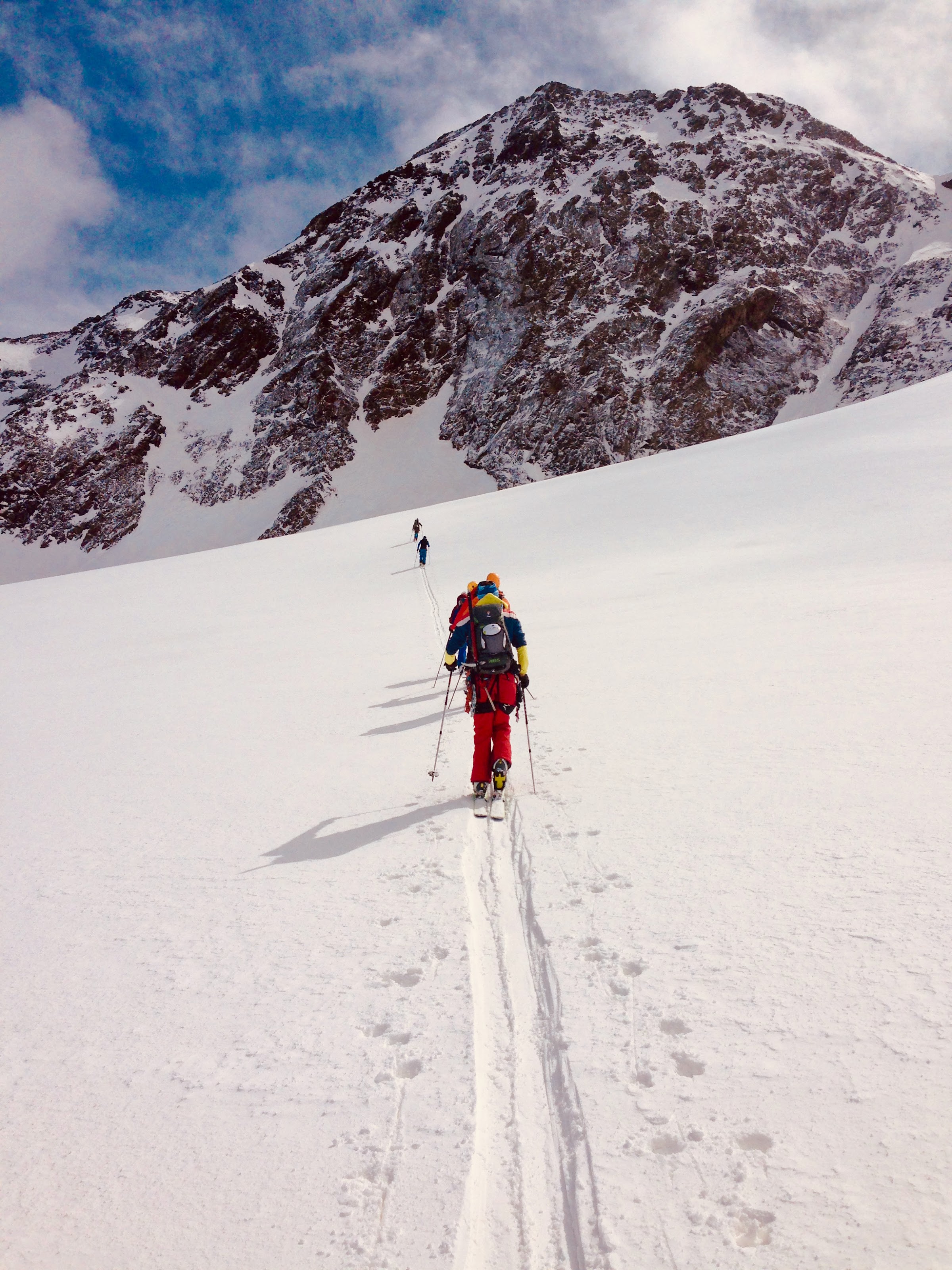
In more than twenty seasons we've seen bluebird mornings that called for great restraint, and grey days when the snow was stable and perfect. Off-piste is above all a matter of reading, and we share that reading with you, slope after slope, on the finest terrain in Val d'Isère.
PowderWeGo, off-piste ski school in Val d'Isère since 2001
As soon as you leave the groomed, marked pistes, you're in avalanche terrain: the risk exists in fine weather too, and a few metres from a piste. Good avalanche safety off-piste means checking the Météo-France bulletin every morning, carrying and knowing how to use an avalanche airbag pack, a transceiver, a shovel and a probe, and being ready to turn back. On a guided outing we provide the safety kit and make those decisions with you. On the marked ski area, closures and signage are there for a reason: please respect them.
FAQ
Where do I find the avalanche bulletin for Val d'Isère?
On Météo-France's mountain pages, in the avalanche bulletin (BRA) for the Haute-Tarentaise massif, published every afternoon for the next day. It gives the danger level from 1 to 5, the altitudes and aspects concerned, and the day's avalanche problem. We read it every morning before setting off.
Which avalanche danger level is dangerous?
Counter-intuitively, level 3 ("considerable") is the deadliest: the snowpack looks stable but a single skier can trigger a slab. Most serious accidents happen at level 3. That is why we read the bulletin every morning and choose the day's slopes to match, which is exactly what skiing with a professional is for.
What safety kit do you need to ski off-piste in Val d'Isère?
An avalanche airbag pack, a transceiver, a shovel and a probe, carried on you, and the practice to use them fast. Speed is what saves lives: after fifteen minutes of burial, the chances of survival fall sharply. On a guided outing, the school provides all four and checks every unit before setting off.
Do you need insurance for off-piste skiing?
Yes. Outside the patrolled ski area, rescue and evacuation can be charged for. Check that your policy covers off-piste rescue, medical costs and repatriation, with off-piste skiing clearly included. Costs vary with the cover you choose (FFS Carte Neige, a dedicated season policy, the option on some premium bank cards): compare policies on their rescue and medical cover rather than on price alone.
Can you ski off-piste in Val d'Isère without a guide?
Yes, the law allows it. Reading the stability of the snowpack, though, is a lifetime's craft that goes far deeper than the eye can see from a chairlift. Until snow science, terrain reading and transceiver search are second nature, skiing with a professional is the best way to head home in the evening with the finest snow of the day behind you.
What is a wind slab?
A cohesive layer of snow laid down by the wind on top of a weak layer. Smooth on the surface, hollow underneath, it breaks in one piece when a skier loads it and often releases above them, across the whole width of the slope. It's the most common and most serious avalanche danger.