Heliskiing in Italy · Val Veny, Aosta Valley · organised from Val d'Isère
Heliskiing at Courmayeur: ski the Italian side of Mont Blanc from Val d'Isère
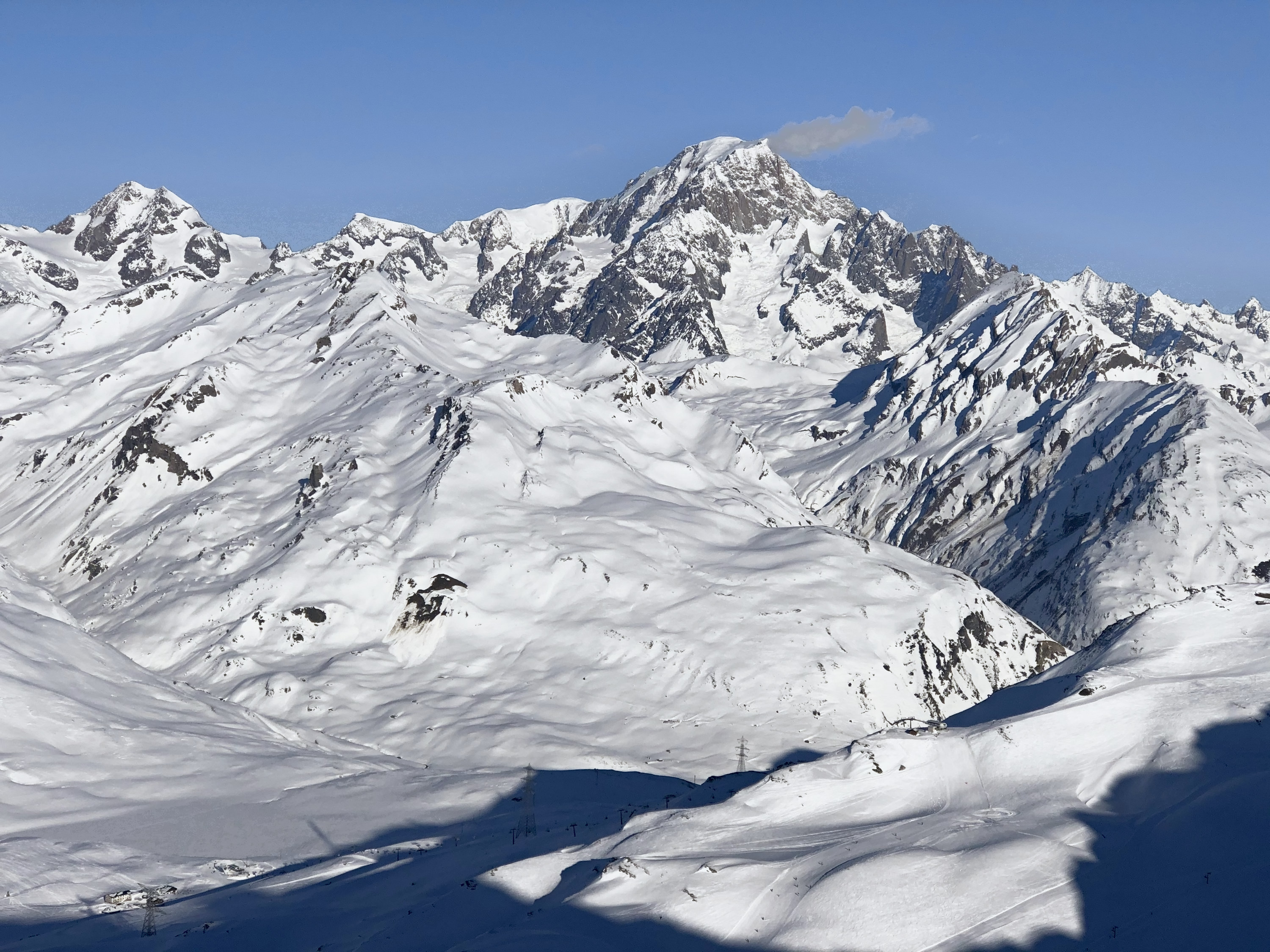
Ski the Val Veny amphitheatre under the south face of Mont Blanc, on glacier drops of 800 to 1,600 metres, with a guide who picks the aspect on the morning itself, by what the night left behind.
In brief
- Where
- Val Veny, Aosta Valley: the Italian side of Mont Blanc, above Courmayeur
- Terrain
- the Val Veny glacial amphitheatre: drops of 800 to 1,600 m of vertical, from good off-piste to high-mountain skiing
- A typical day
- several drops depending on the snow and the group's level, from Mont Fortin to the big glacier routes
- Level
- a good, self-sufficient off-piste skier; the high glacier drops call for an advanced to expert level
- Guiding
- a mountain guide, with closer guiding on the glacier; avalanche airbag pack, transceiver, shovel and probe provided
- Departure
- from Val d'Isère and back in the day, by minibus or by helicopter (Courmayeur lends itself well to a quick helicopter hop)
- Price
- on request, set by the rotations flown, the group size and the transfer
- Season
- deep winter for cold snow; the high glacier terrain tends to settle later in the season
Mont Blanc fills your sky: Courmayeur from Val d'Isère
There's a moment, in the morning, when the helicopter swings over the Val Veny and Mont Blanc leaves the postcard at the end of the valley to fill the sky overhead, with its ridges, its seracs and its sheer mass of ice and rock. That's heliskiing at Courmayeur: skiing the Italian side of the massif, the one the people of the Aosta Valley call their own mountain, in a glacial amphitheatre open to the 4,000-metre peaks.
From Val d'Isère it's a short hop. You cross to the Aosta side, the light turns drier and sunnier, and you find another way of doing the mountains: the short, strong coffee, the easy welcome, a lunch that matters as much as the slope. The Val Veny packs into a small space the best of what heliskiing offers: short hops between drops, fine glacier skiing, and Mont Blanc in front of you all day. The line itself is chosen that morning, wherever the snow is best on this side of the mountain.
See all our heliski formats · Tell us your dates
Your heliski day at Courmayeur, from kit check to last run
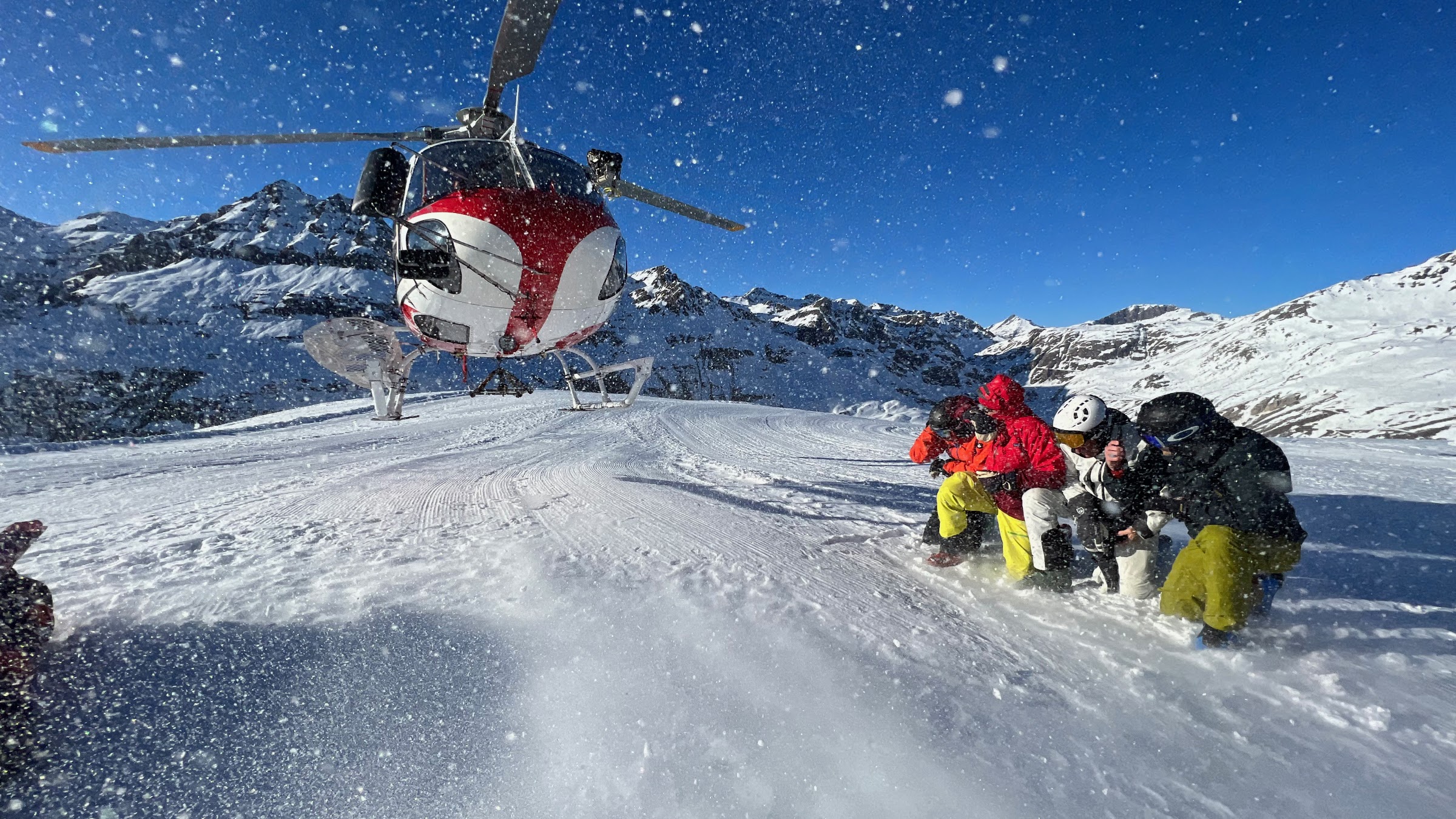
First job at the helipad: everyone is handed an avalanche airbag pack, a transceiver, a shovel and a probe; we check every transceiver for send and receive before anyone thinks about flying. The guide reads the snow (the Aosta Valley bulletin, the previous day's observations, the wind direction) and settles on the first sector. Then it's into the heli for the first drop.
After that, you ski and fly back up. A rotation is a drop up high, a descent to a pick-up point, often towards the Lac Combal or the floor of the Val Veny, then the heli to collect the group for the next aspect. The Val Veny has a rare advantage: the sectors sit close together, the helicopter makes quick work of the hops, and a good day strings the rotations together with barely a pause. On the glacier drops the guiding tightens: roped up when needed, the route chosen crevasse by crevasse, the pace set by the terrain. That's the craft.
The vertical counter tells only part of it. The day lives in the moment the helicopter pulls away, the noise drops all at once, and all that's left is the glacier, the group and a fresh track to lay under the south face of Mont Blanc.
Ski the Val Veny amphitheatre, sector by sector
Heliskiing in the Val Veny reads like an amphitheatre: drops stepped from Mont Fortin (2,700 m, glacier-free, the opener) up to the big glacier routes of the Aiguille des Glaciers and the Piton des Italiens, higher, more alpine, kept for good conditions. In between runs a whole range (Lex Blanche, Aiguille de l'Aigle, Tré-la-Tête) that lets the guide build the day by the snow and the group's level.
The Aosta operators keep their exact drop coordinates to themselves, and so do we, since a landing spot depends on the day: the landmarks we give are sector and summit references, and the guide chooses the actual drop that morning, by the snowpack and the weather window. That's how glacier heliskiing works, and it's what makes it a real high-mountain day.
Like Courmayeur, heliski at Valgrisenche and heliski at La Thuile make a fine day out from Val d'Isère; heli skiing at Cervinia, heliski at Monterosa, heliski at Sestriere and heli skiing at Zermatt call for a stay.
Priced to order, quoted within 24 hours
Every heliski day is built to order and priced on three things: the number of rotations, which sets the vertical skied, the size of the group, and the transfer from Val d'Isère, by minibus or helicopter.
Send us your dates, the number of skiers and how much skiing you'd like, and a quote reaches you within 24 hours.
From the gentlest opener to the most alpine: the Val Veny sectors
Each landmark below is an indicative map reference for a sector or a summit. The guide chooses the real landing spot on the morning, by the snow, the wind and the hazard. Vertical figures are those published by Aosta Valley sources, as an order of magnitude.
Mont Fortin — 2,700 m, 1,100 m of descent, glacier-free. The ideal way into heliskiing at Courmayeur: the full Mont Blanc setting, varied skiing and quick access from the ski area. The sector that warms up the legs and serves as a barometer for the day's snow. Intermediate / good off-piste skier.
Lower Pyramides — 2,800 m, 800 m of descent, glacier-free. The most accessible drop in the area, valuable for a first taste of heliskiing or on days when the glacier terrain calls for more caution. Easy to intermediate.
Aiguille de la Lex Blanche — 3,200 m, 1,200 m of descent, glacier. The great glacier classic of the Val Veny: the Lex Blanche glacier unrolls towards the Lac Combal and the Miage, with direct views of Mont Blanc and its wild ridges. Intermediate to advanced.
Aiguille de l'Aigle — 3,200 m, 1,200 m of descent, glacier. A very scenic drop facing Mont Blanc, fine glacier skiing and a good variety of pitch, dropping into the Lex Blanche amphitheatre. Intermediate.
Colle de la Scie, high drop, up to 1,720 m of descent, high mountain. The big-scale option to make the most of the vertical in full high-mountain surroundings, finishing towards the Combal and the Val Veny depending on conditions. Advanced.
Aiguille de Tré-la-Tête — 3,400 m, 1,500 m of descent, glacier. A long, very visual glacier variant, with a real sense of commitment above the Val Veny, on the Lex Blanche glacier. Intermediate to difficult depending on the drop.
Aiguille des Glaciers — 3,500 m, 1,500 m of descent, glacier. The finest drop on the Italian side of Mont Blanc: high mountains, big glaciers, length and genuine alpine intensity, sometimes linked with a second drop. Advanced to difficult.
Piton des Italiens — 3,800 m, 1,600 m of descent, glacier. A major route, spectacular and demanding, on glaciated terrain, best kept for late in the season when the snowpack settles. Difficult.
And, right at the top, there's the legend. Some sources mention a drop on the very summit of Mont Blanc, at around 4,810 metres. As we see it, that's an exceptional and strictly conditional possibility, more legend than standard product. It is discussed only case by case, with a mountain guide, subject to conditions and permissions. We mention it here for completeness.
The guide draws on a handful of these sectors each day, in the order the snow dictates, wherever the best of it lies.
Follow a Val Veny day, from morning to evening
Morning. Meeting point, safety kit handed out and checked, the guide's briefing on the snow and the chosen sector. First flight, first drop above the Val Veny.
The rotations. Each rotation links a drop, a descent to a pick-up point towards the Combal or the valley floor, then a new flight. The Val Veny being compact, the heli switches quickly from one sector to the next: little waiting, a lot of skiing.
On the glacier. As soon as we ski glaciated terrain (Lex Blanche, Aiguille des Glaciers, Piton des Italiens), the guide reads the crevasses, ropes up if needed and lays the route on the safest line. We move at the terrain's pace.
Lunch. Between two aspects, we stop in the sun. The Aosta side knows how to feed you: a mountain dish, a coffee, and off again.
End of the day. Last run, pick-up, back towards Val d'Isère with the south face of Mont Blanc still in your eyes.
Your safety: the rules we always keep
Every Val Veny slope is unpatrolled, glaciated high-mountain terrain, so here safety comes before every other consideration.
The kit, at every rotation. Each skier is equipped with an avalanche airbag pack, a transceiver, a shovel and a probe. Everything is handed out at the helipad, each transceiver tested for send and receive, then tested again whenever the group flies in separate rotations.
The glacier, one notch up. Skiing the big Val Veny sectors means skiing glaciers. The guiding is closer there: the guide reads the crevasses, picks the safest route and ropes up when needed.
The snowpack, read every morning. Before choosing a sector, the guide weighs the Aosta Valley avalanche bulletin against what he has seen on the snow and the week's history. Yesterday's good slope is read afresh every morning.
The wisdom to turn back. Calling off a rotation takes as much skill as stringing them together. If the avalanche danger is high or the window too short, we scale back, change sector, or leave the helicopter on its pad. That judgement is the most valuable thing we bring to your day.
The guiding. Glaciated terrain like this calls for a mountain guide, and one leads every day. As for the law: heliskiing, banned in France, is fully legal in Italy, which is what puts Courmayeur within reach of Val d'Isère.
> Beyond the marked pistes, the high mountains carry risks of their own: kit and guiding reduce the avalanche risk and the glacier hazard, and help manage what remains. The snow, the weather and the visibility can shorten, move or cancel a day at any moment, and we honour those rules of the high mountains every time.
Reach the Val Veny by road or by air
That's the whole point of booking with us: you stay in Val d'Isère. We organise heliskiing at Courmayeur from Val d'Isère, there and back in the day.
Two ways to reach the Val Veny.
- By minibus · by road to the departure base on the Aosta side, the simplest and most flexible to arrange.
- By helicopter · Courmayeur lends itself well to a quick helicopter hop: a transfer by air saves time and lets you start skiing earlier, depending on the day and the group.
We settle the transfer with you at booking, according to the number of skiers, the weather window and the volume of skiing you're after. The price is built on request: number of rotations, group size, chosen transfer.
Our side of things · liaising with the Aosta base, the guide, the safety kit and the rhythm of the day. Yours · your own skis and boots (wide freeride skis are best, and hire is easy to arrange), your mountain clothing, your picnic or a refuge stop.
Cold midwinter snow or late-season glaciers: time your Val Veny day
Heliskiing in Italy depends above all on the snow cover and a clear weather window. Midwinter brings the coldest, lightest snow to the north-facing sectors and to openers like Mont Fortin. The big glacier routes (Aiguille des Glaciers, Piton des Italiens) are best skied late in the season, when the snowpack settles and crevassed terrain becomes easier to read.
The Aosta side has a deserved reputation for sunshine: you often ski under a big blue sky. Heliskiing still depends on visibility: the heli needs clear air, and glacier skiing needs it even more. So we leave a little room in the dates, with off-piste skiing in Val d'Isère as the alternative if the window shuts.
Safety in the high mountains. Heliskiing takes place on unmarked, unpatrolled terrain in glaciated high mountains. Before each flight we hand out and test the safety kit (avalanche airbag pack, transceiver, shovel and probe). On the glacier the guiding draws closer, the guide tracks the avalanche bulletin and the snowpack day by day, and any day can be adapted or postponed when conditions call for it. Good kit is the foundation; on it we build preparation, a fine read of the terrain and the judgement to turn back. Italian law permits every drop we make here.
FAQ
Is heliskiing legal at Courmayeur?
Yes. Italian law permits heliskiing, and the Val Veny above Courmayeur is one of its classic settings in the Aosta Valley; in France it is banned. Organising the day from Val d'Isère is simply a matter of crossing the border to the Italian side.
What standard of skiing does heliskiing at Courmayeur call for?
You need to be a good, self-sufficient off-piste skier, at ease in variable snow. Openers like Mont Fortin or the Lower Pyramides stay accessible; the big glacier routes (Aiguille des Glaciers, Piton des Italiens, the high variants of Tré-la-Tête) call for an advanced to expert level and real high-mountain experience.
Do you ski glaciers at Courmayeur?
Yes, most of the big Val Veny drops are glaciated: Lex Blanche, Aiguille de l'Aigle, Aiguille des Glaciers, Piton des Italiens, Tré-la-Tête. That's what makes the area so fine, and what calls for closer guiding by a mountain guide, reading the crevasses and choosing the safest route.
Can you ski from the summit of Mont Blanc?
Some sources mention a very high drop on the massif. We treat it as an exceptional and strictly conditional possibility, considered case by case with a mountain guide, subject to conditions and the permissions in force; it sits apart from our standard days.
Can we pick our descents in the Val Veny ahead of time?
No, and with good reason: the guide settles the programme that morning, by the snow and the weather. From the Val Veny sectors, he picks the aspects that hold that day, and that is how you end up on the snow that's skiing best.
How do you get from Val d'Isère to Courmayeur?
Two options, settled with you at booking: by minibus on the road, or by helicopter to save time and start skiing earlier. Courmayeur lends itself well to a quick helicopter hop. We choose according to the number of skiers, the weather window and the volume of skiing you're after.
How much does a heliski day at Courmayeur cost?
It's priced on request, since it turns on the number of rotations, the size of the group and the transfer from Val d'Isère. Share your dates and plans, and a quote follows within 24 hours.
Let's find your day in the Val Veny
Tell us your dates and group size, and within 24 hours you'll have a quote and the Val Veny sectors that suit you, from Mont Fortin to the big glaciers.